Admissibility vs Accessibility: A Minimal Rate-Dependent Constraint on Reachability in Dynamical Systems
Foundational preprint
This work extends the core admissibility condition by introducing a dynamical perspective on state reachability under finite recovery constraints.
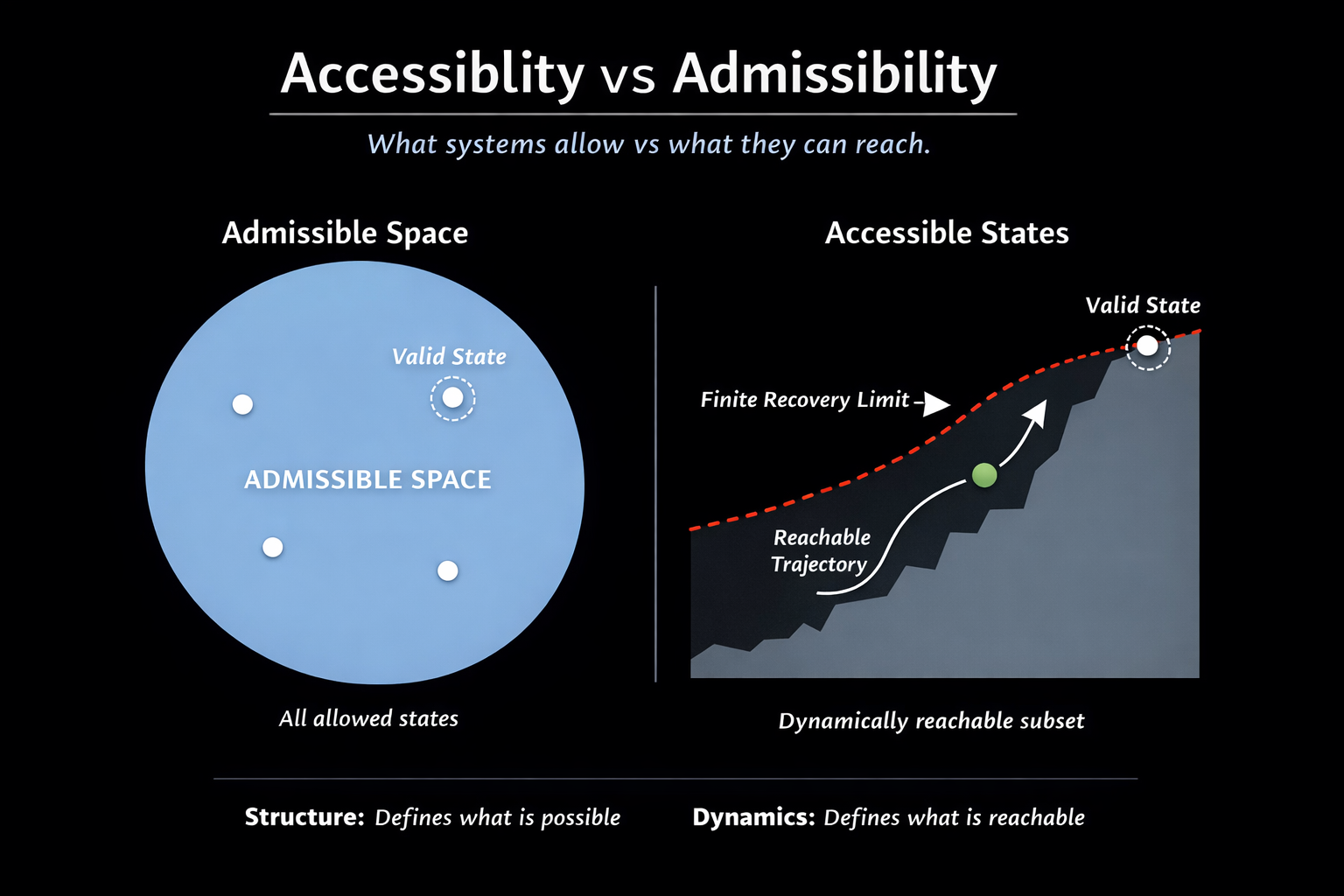
Accessibility vs Admissibility (Zenodo, 2026) examines how systems may retain structurally valid states that become dynamically unreachable when recovery processes fail to keep pace with imposed demand
Abstract (Index version)
The accessibility vs admissibility distinction introduces a minimal dynamical refinement to the admissibility constraint.
A system may remain structurally well-defined — preserving its state space — yet lose functional access to specific states when recovery processes operate under finite rates.
In this view, failure does not necessarily arise from structural breakdown or state removal, but from a loss of dynamically admissible trajectories within a finite recovery window.
This framework suggests that system behavior may depend not only on total input or structural configuration, but on whether recovery dynamics remain sufficiently matched to the rate of perturbation.
Notably, increasing input intensity or optimization pressure may reduce accessibility, even when the underlying states remain intact.
The proposal is formulated as a falsifiable structural hypothesis, consistent with systems in which function depends on timely reintegration, including physical, biological, and information-processing domains.
DOI (Zenodo)