
GitHub Experiments
Executed notebooks, simulations, reproducible figures, and operational modeling experiments connected to the framework.
-
GitHub
- May 29, 2026 ERC Accessibility Forecasting May 29, 2026
- May 26, 2026 Dynamic Accessibility Organization Under Perturbation–Recovery Constraints May 26, 2026
- May 20, 2026 A Minimal Computational Framework for Accessibility Erosion and Operational Geometry May 20, 2026
- May 11, 2026 Progressive Future Accessibility Loss May 11, 2026
- May 7, 2026 Functional Time and Recoverability Window May 7, 2026
- May 4, 2026 Oxygen-centered dynamical organization of chemical space May 4, 2026
- Apr 27, 2026 Oxygen-relative chemical space may encode structured dynamical accessibility regimes Apr 27, 2026
- Apr 17, 2026 Oxygen and sulfur appear to define a shared local geometry in multivariable periodic table space Apr 17, 2026
- Apr 4, 2026 Heterogeneous Recoverability in Gene Expression —Post-Hypoxia Reoxygenation (GSE1041) Apr 4, 2026
- Mar 26, 2026 Endogenous Reachability Collapse (ERC) — Minimal Recoverability Framework Mar 26, 2026
- Mar 23, 2026 Endogenous Reachability Collapse (ERC) — Rate-dependent Reachability Collapse Mar 23, 2026
- Mar 23, 2026 Endogenous Reachability Collapse (ERC) — Ensemble Behavior Mar 23, 2026
- Mar 22, 2026 Endogenous Reachability Collapse (ERC) — Minimal Dynamical Model Mar 22, 2026
- Mar 20, 2026 Structural Accessibility Boundary — Minimal H–O Redox Network Mar 20, 2026
- Mar 17, 2026 Oxygen Regime Boundary — Minimal Model Mar 17, 2026
- Mar 17, 2026 Functional Boundary Analysis in a 2D Nonlinear System Mar 17, 2026
- Mar 17, 2026 The Oxygen Octave — v1.6.1 Mar 17, 2026
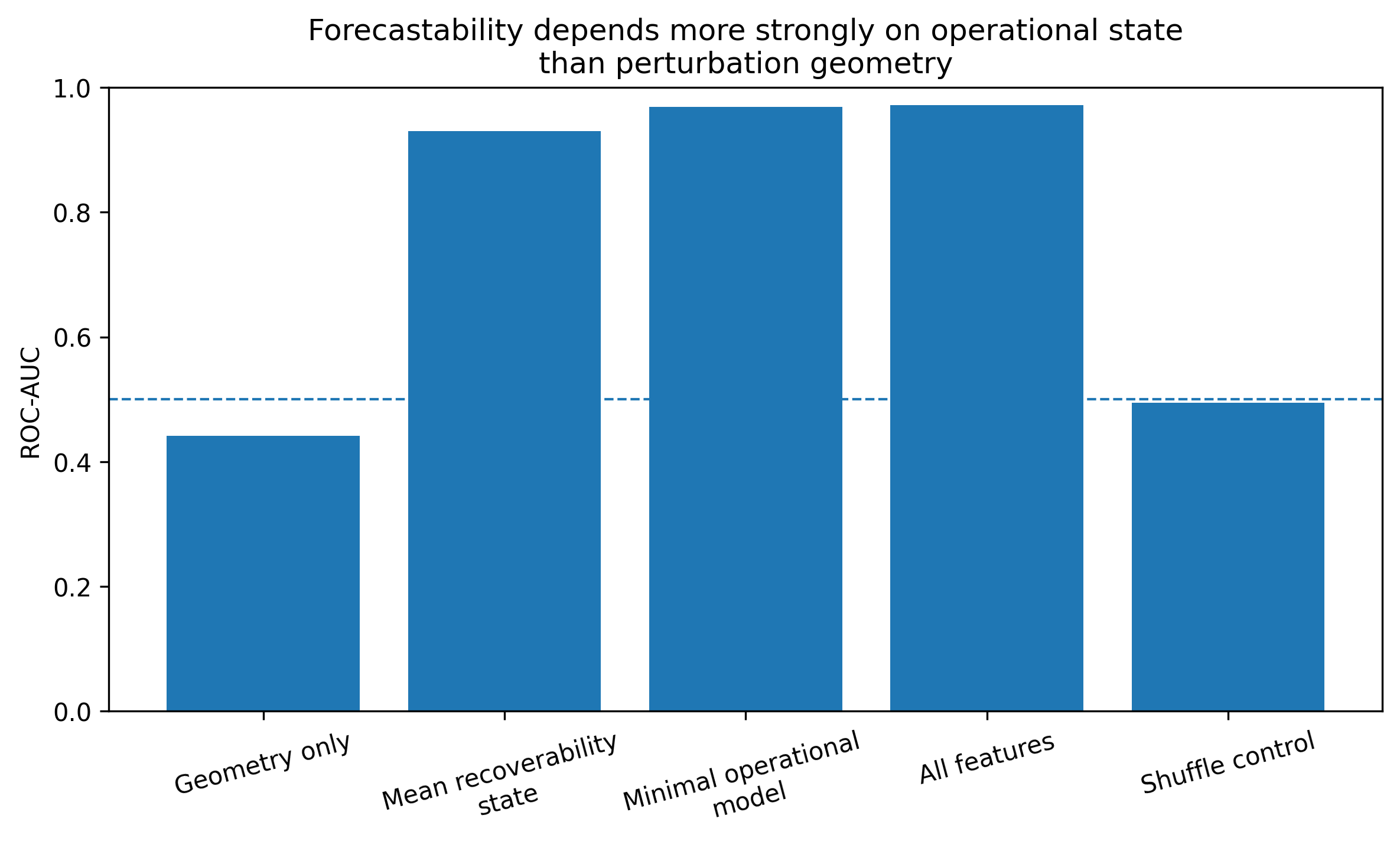
ERC Accessibility Forecasting
ERC Accessibility Forecasting
Minimal recoverability-constrained forecasting framework exploring whether future accessibility deterioration may become forecastable before explicit collapse.
Simulations suggest predictive signal may emerge more strongly from present operational recoverability organization than from perturbation geometry alone.
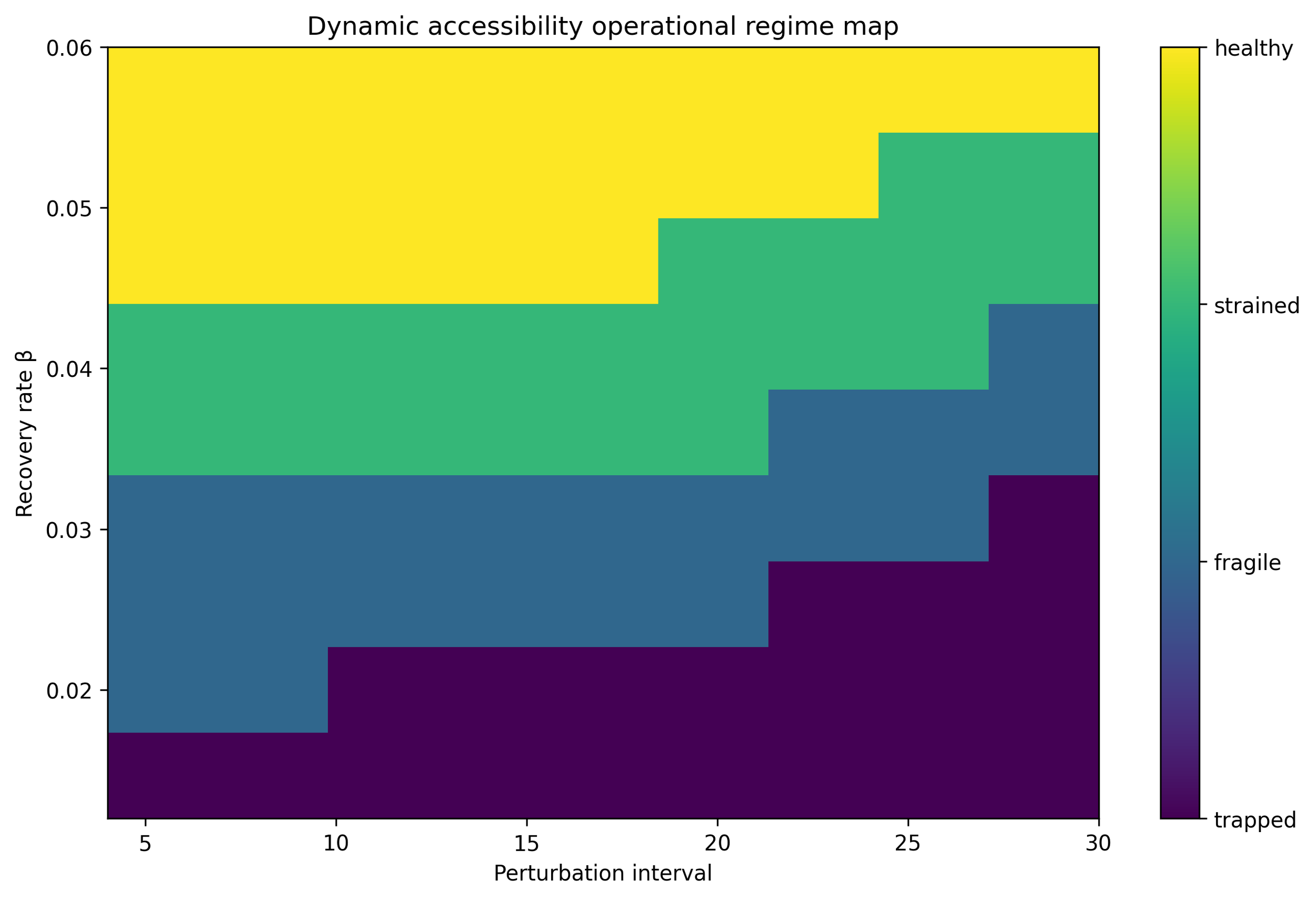
Dynamic Accessibility Organization Under Perturbation–Recovery Constraints
This work explores whether systems may preserve structural scaffold while progressively reorganizing which futures remain operationally accessible under perturbation–recovery constraints.
Using a minimal lattice-based computational framework, the simulations examine how perturbation timing, recovery kinetics, perturbation history, and stochastic variability may reorganize accessibility while scaffold structure remains preserved.
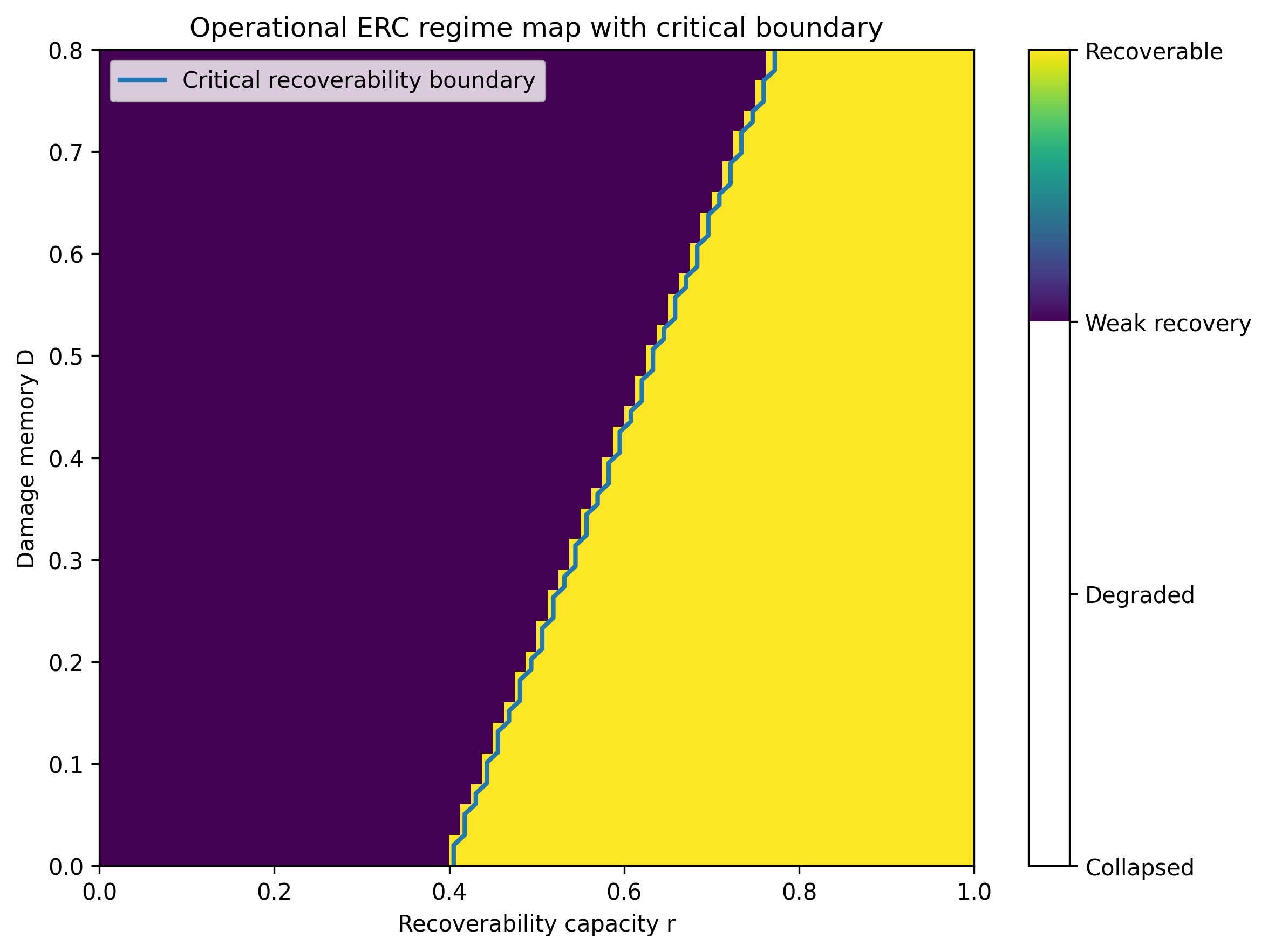
A Minimal Computational Framework for Accessibility Erosion and Operational Geometry
This work introduces a minimal computational framework exploring how repeated perturbation history, recoverability depletion, and accumulated operational memory may progressively reorganize which future trajectories remain operationally accessible in recoverability-constrained dynamical systems.
Rather than focusing solely on immediate dynamical collapse, the framework investigates whether systems may remain dynamically active while progressively losing access to recoverable future regions under repeated perturbation exposure.
The simulations reveal emergent structures including accessibility basin erosion, phase-dependent recoverability, internal operational geometry, fragmentation thresholds, scaling behavior, and localized hysteresis-like dynamics near operational accessibility cliffs.
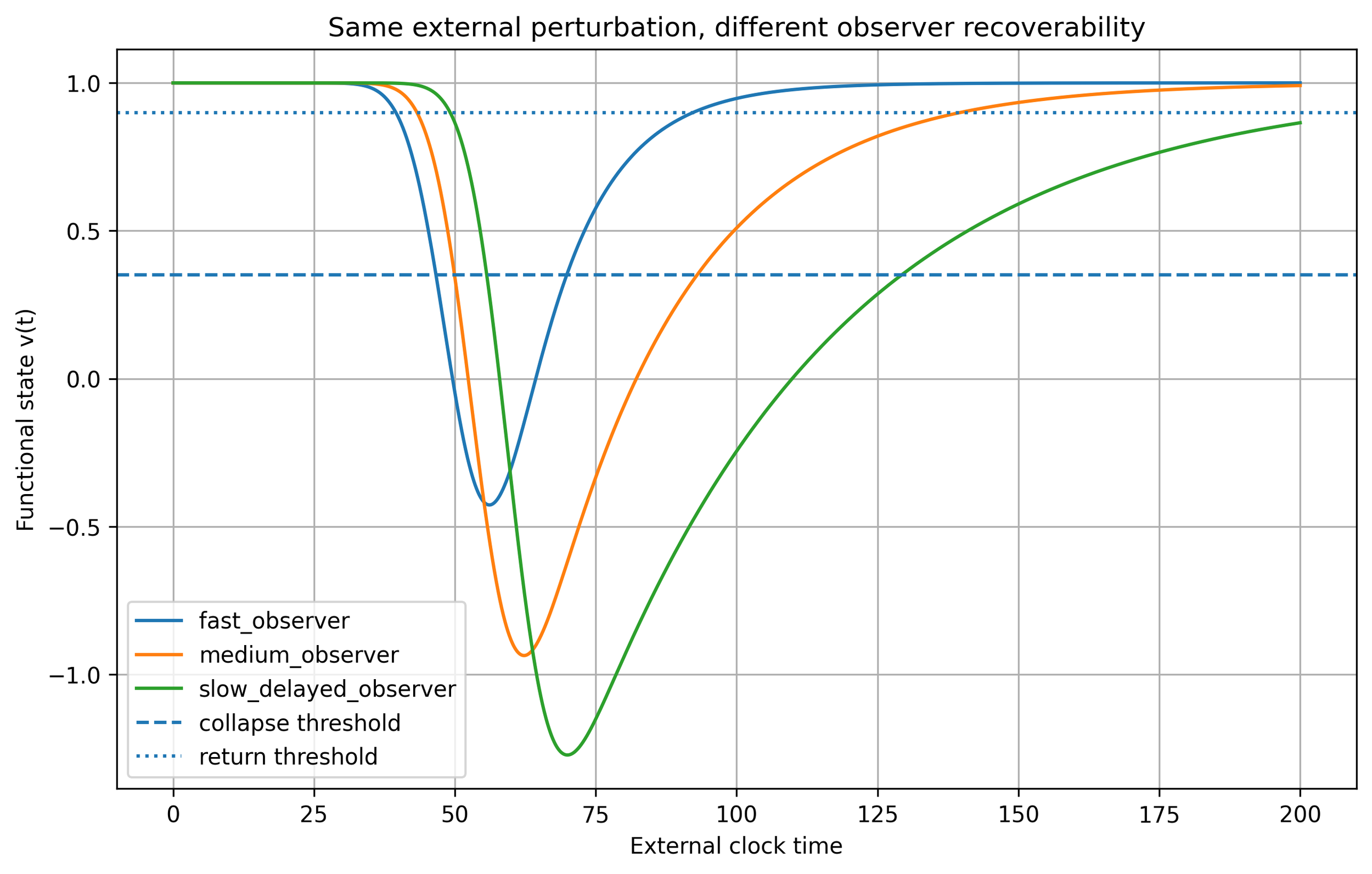
Progressive Future Accessibility Loss
This work introduces a minimal computational framework exploring how recoverability-constrained dynamical systems may progressively lose operational access to future regions despite remaining dynamically active under shared external temporal progression.
Using heterogeneous recovery dynamics under identical perturbation schedules, the simulations exhibit operational temporal divergence, accessibility fragmentation, stochastic accessibility degradation, and horizon-like accessibility regimes.
The central phenomenon explored throughout the framework is that systems may remain dynamically active while progressively losing operational access to portions of their future accessibility landscape long before complete dynamical collapse occurs.
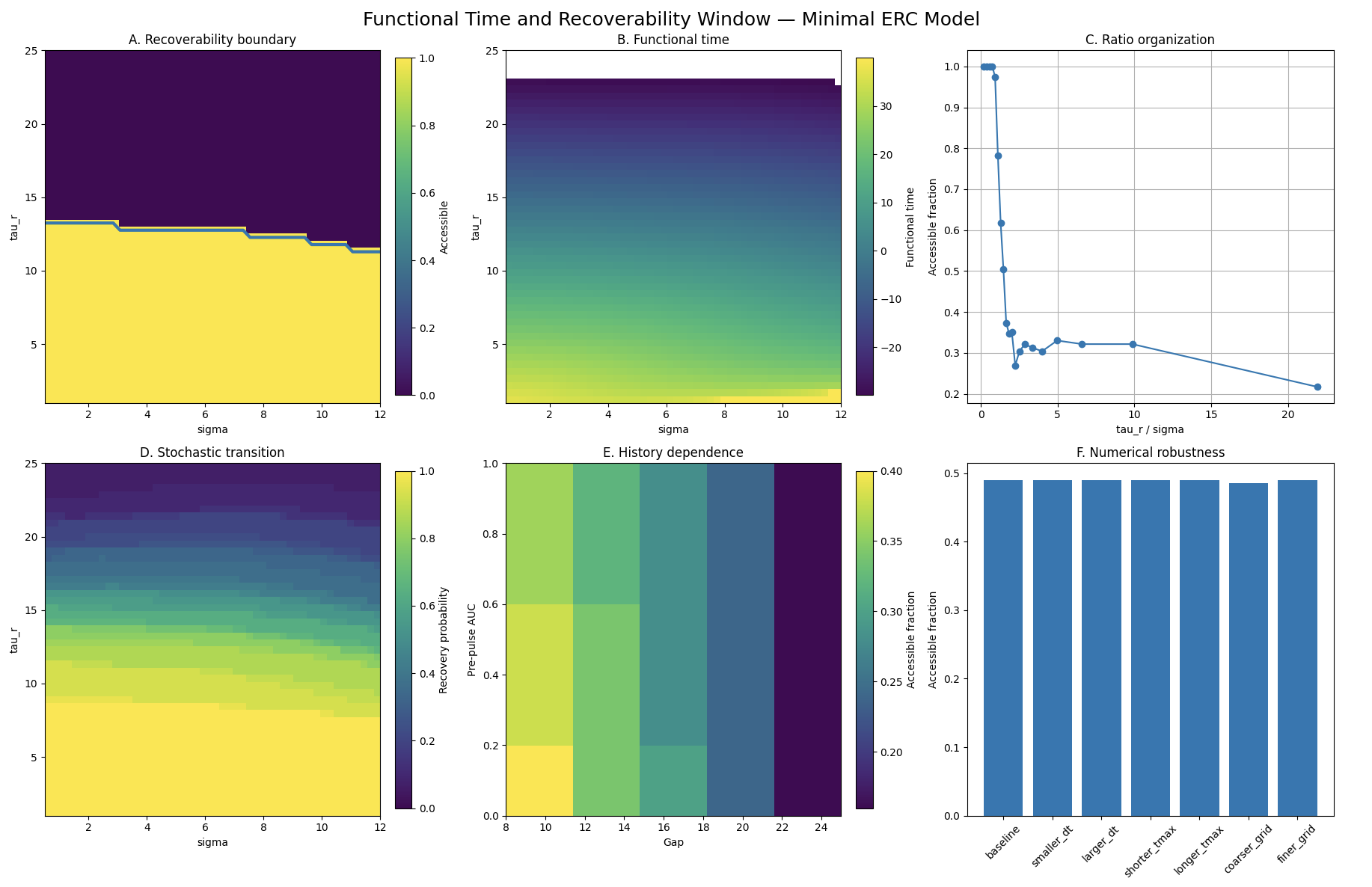
Functional Time and Recoverability Window
This work explores whether systems may progressively lose operational recoverability before complete dynamical collapse occurs.
Rather than asking only whether trajectories formally exist, the framework investigates whether recoverable return pathways remain dynamically accessible within finite operational windows.
Using a minimal ERC (Endogenous Reachability Collapse) framework, the simulations explore how operational accessibility may degrade progressively under finite-time perturbation and recovery dynamics.
The resulting structure reveals recoverability boundaries, ratio-organized accessibility transitions, stochastic accessibility bands, history-dependent recovery behavior, and numerically robust transition structures across parameter space.
Rather than interpreting recoverability as a purely binary property, the framework investigates transition regions where systems retain formal dynamical structure while progressively losing accessible recovery pathways.
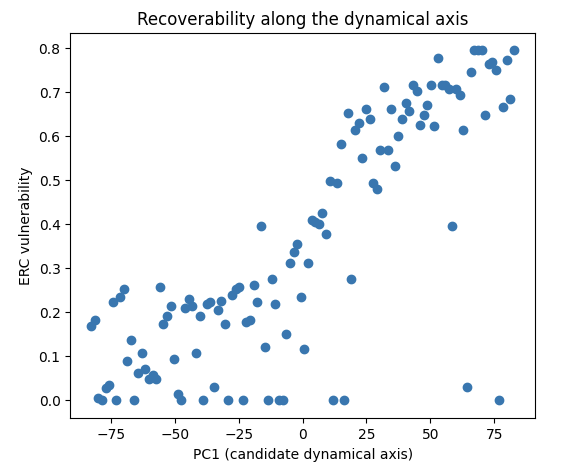
Oxygen-centered dynamical organization of chemical space
This work explores whether oxygen-centered representations of chemical space may reveal an underlying dynamical organization.
While chemical space is typically described in terms of similarity and static properties, this framework asks a different question:
not just which states exist —
but which remain dynamically reachable.
Using a minimal Endogenous Reachability Collapse (ERC) framework, each element is embedded in an oxygen-relative representation and subjected to controlled perturbations, allowing the system to be probed in terms of recoverability rather than proximity.
This framework extends prior observations from oxygen-centered geometry and oxygen-relative chemical space by introducing a dynamical criterion: recoverability under transient forcing, suggesting that these structures may reflect an underlying dynamical constraint rather than purely geometric organization.
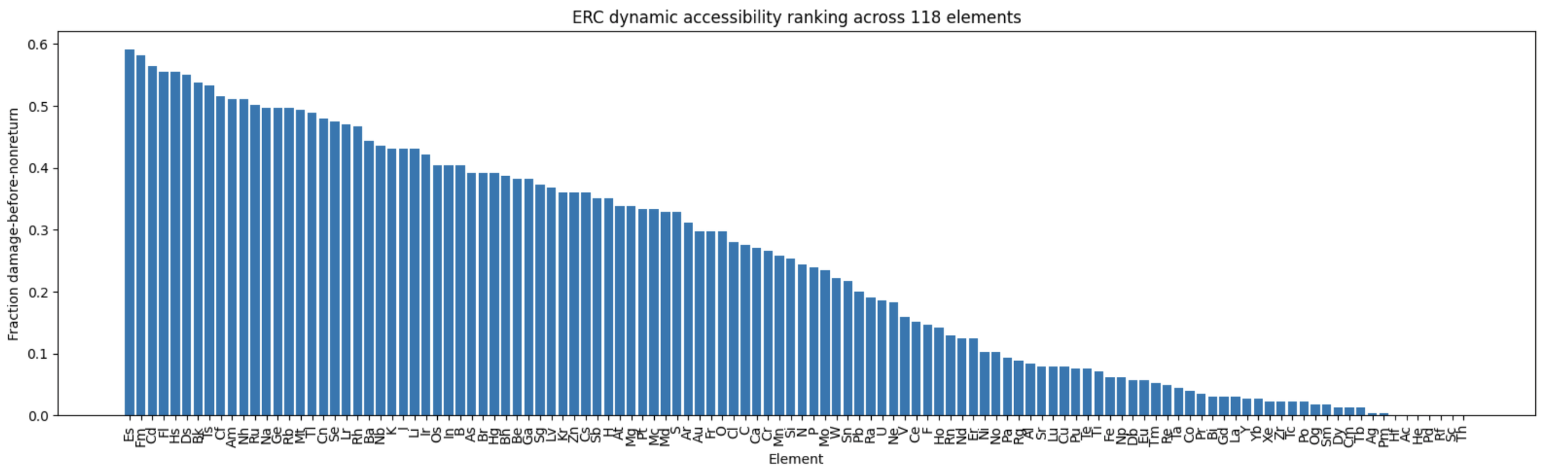
Oxygen-relative chemical space may encode structured dynamical accessibility regimes
We present a minimal dynamical framework to explore whether accessibility across chemical elements is determined solely by geometric proximity or constrained by recoverability under transient forcing. Results suggest that oxygen-relative chemical space may encode structured dynamical regimes not reducible to static distance alone.
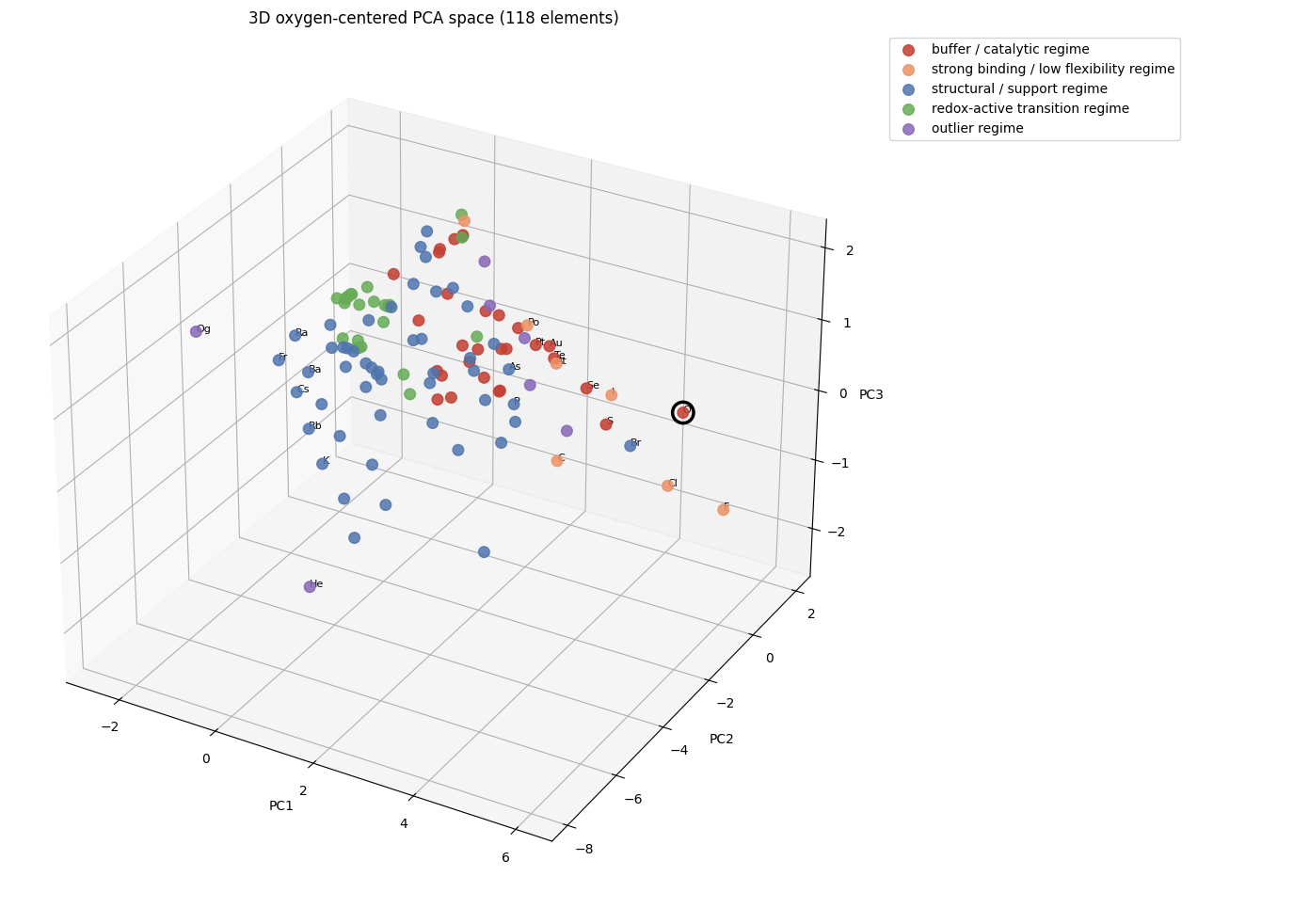
Oxygen and sulfur appear to define a shared local geometry in multivariable periodic table space
A multivariable PCA analysis of all 118 elements suggests that oxygen occupies a distinct and non-random local neighborhood enriched in sulfur-family elements, halogens, and catalytic metals.
Sulfur reproduced the oxygen-centered neighborhood most closely and generated the most compact local geometry across the tested reference elements.
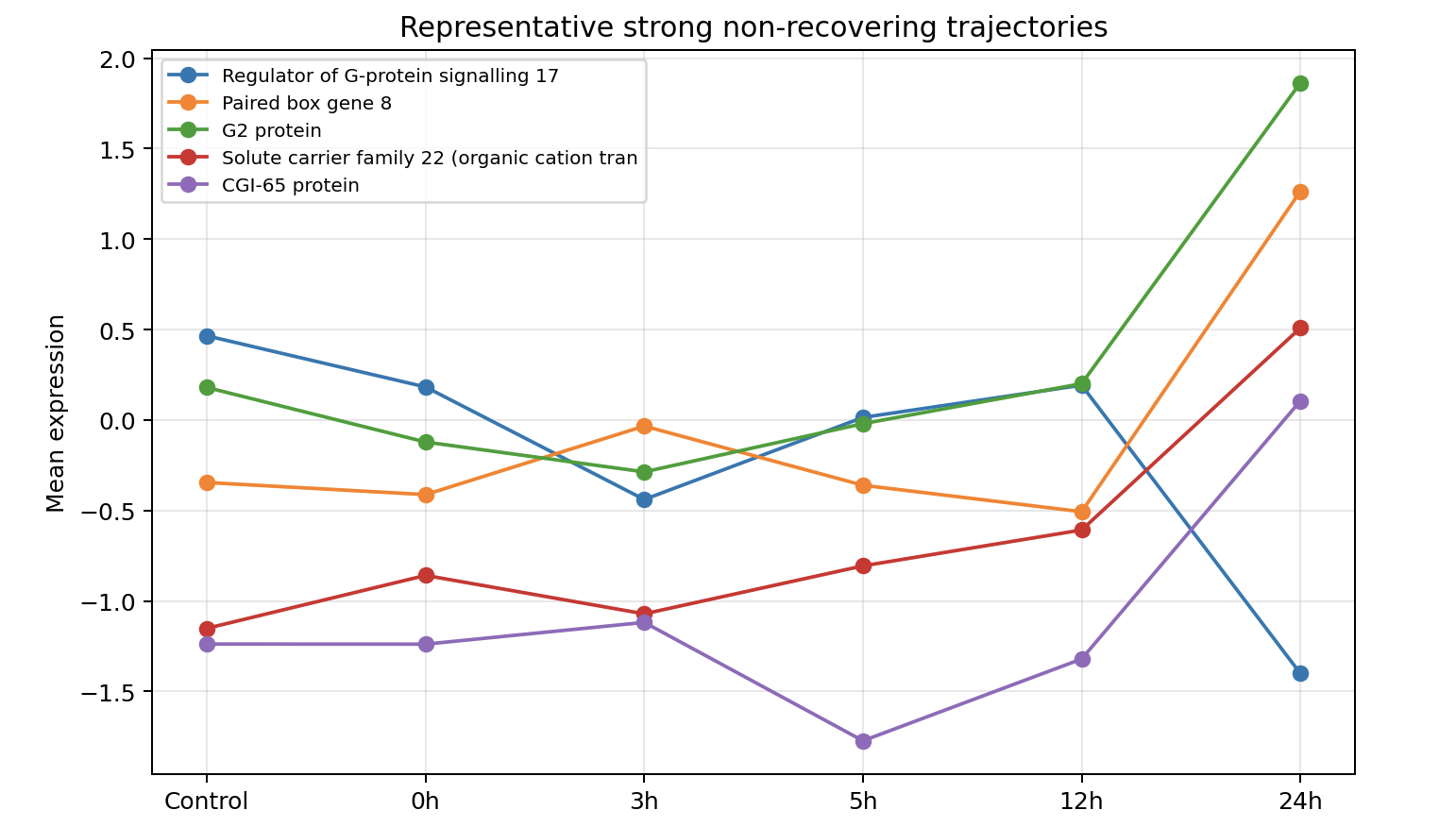
Heterogeneous Recoverability in Gene Expression —Post-Hypoxia Reoxygenation (GSE1041)
A minimal analysis exploring whether gene expression recovery after hypoxia remains uniformly accessible across all trajectories.
While biological systems are often described as robust, this work examines whether recovery within finite time windows may be heterogeneous.
We introduce a simple observable:
delta-recovery, which quantifies whether gene expression trajectories return toward baseline within a fixed observation window.
Results suggest that most genes return or remain near baseline, while a non-negligible subset remains displaced at 24h.
This pattern is consistent across thresholds and robust to replicate variability.
These observations are consistent with the possibility that some regions of state space may remain structurally present but become dynamically inaccessible within finite recovery timescales.
This analysis does not demonstrate inaccessibility directly, but provides an observable pattern consistent with time-constrained recoverability.
The framework is intentionally minimal, open, and designed for falsifiability.
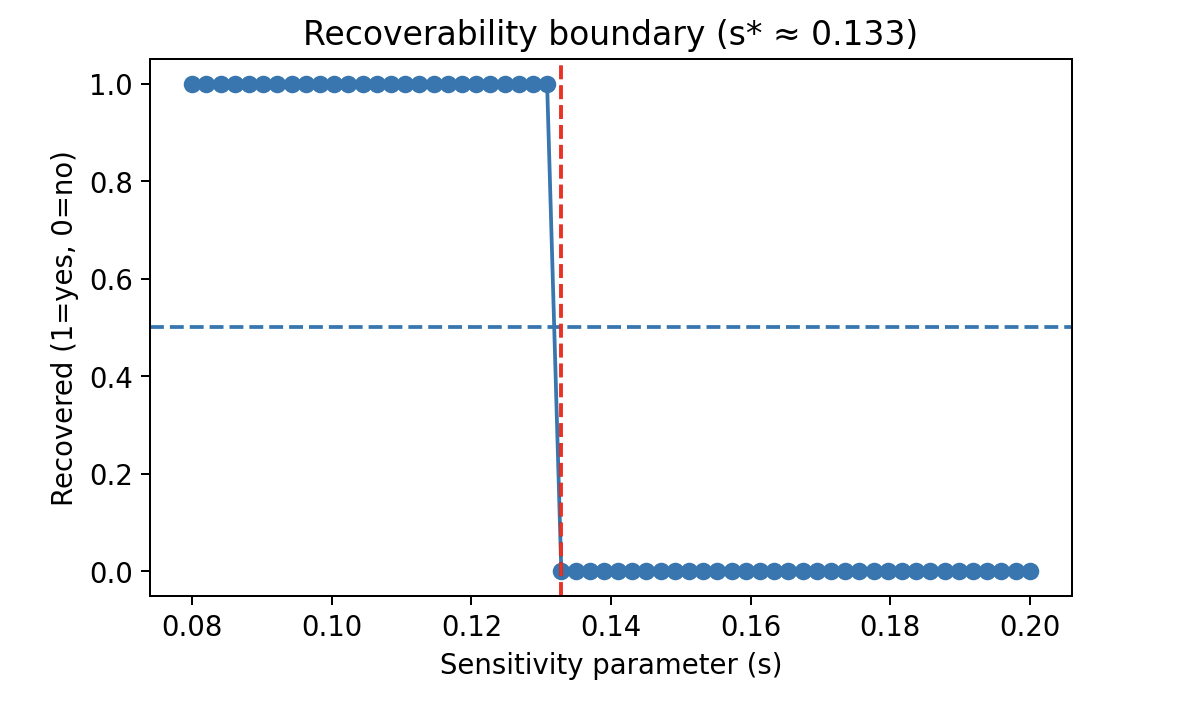
Endogenous Reachability Collapse (ERC) — Minimal Recoverability Framework
A minimal framework exploring whether system failure may emerge from loss of recoverability rather than loss of state space.
The ERC models investigate how accessibility to stable states may depend not only on total perturbation magnitude, but on the relationship between input rate and internal recovery processes.
Numerical results suggest that systems may retain valid states while losing the ability to reach them when driven faster than they can resolve within finite temporal windows.
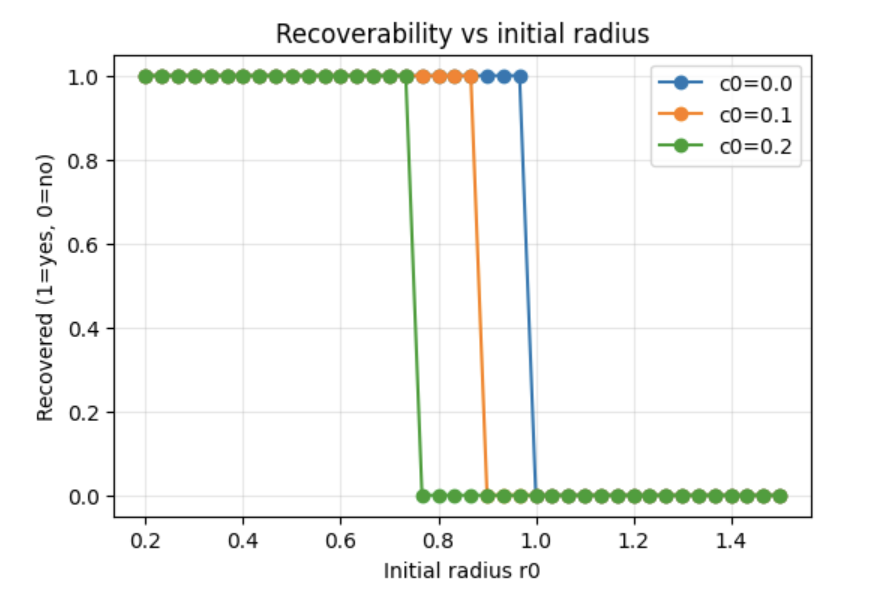
Endogenous Reachability Collapse (ERC) — Rate-dependent Reachability Collapse
A temporal extension of the ERC framework showing that loss of recoverability may depend not only on the magnitude of perturbations, but on the rate at which they are applied.
Simulations reveal that even with identical total input (AUC), faster forcing can drive the system beyond its recoverable regime, while slower inputs remain accessible.
This rate dependence appears as a shift in the effective recoverability threshold: the attractor persists, but becomes dynamically unreachable when the system is driven faster than it can recover.
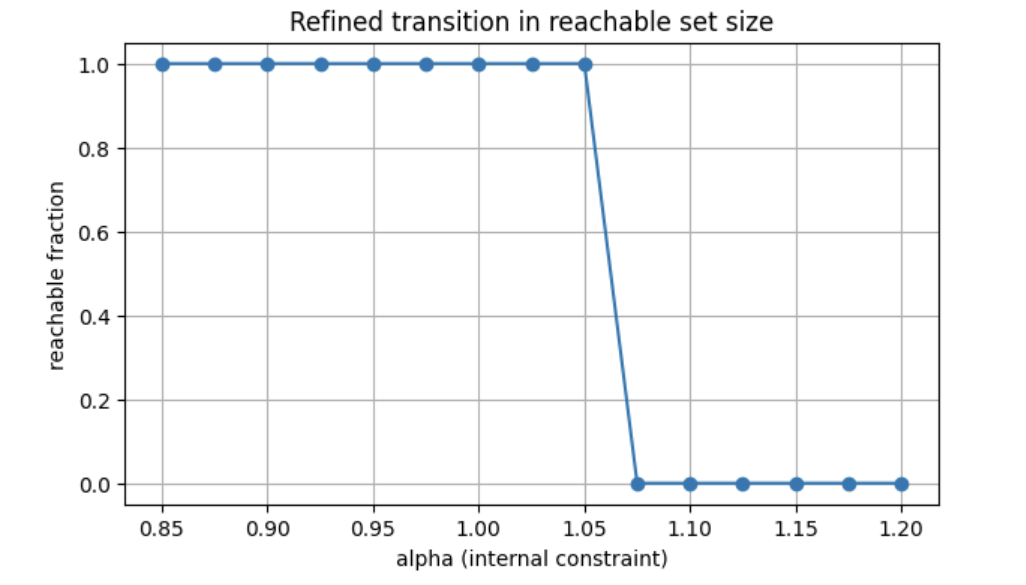
Endogenous Reachability Collapse (ERC) — Ensemble Behavior
A minimal extension exploring how loss of recoverability emerges at the level of initial condition distributions.
While the minimal model shows that a stable attractor can become dynamically inaccessible, this work examines how that transition appears across an ensemble of initial states.
As internal constraint increases, the fraction of initial conditions that return to the base attractor progressively contracts, providing an operational measure of accessibility.
This reveals that loss of function may first appear statistically, as a shrinking basin of recovery, before becoming absolute at the level of individual trajectories.
The attractor remains present in the state space, but becomes reachable only from a diminishing subset of initial conditions.
This suggests that system robustness depends not only on structure, but on how accessibility is distributed across state space under constraint.
This ensemble perspective extends the ERC framework by introducing a measurable indicator of recoverability loss.
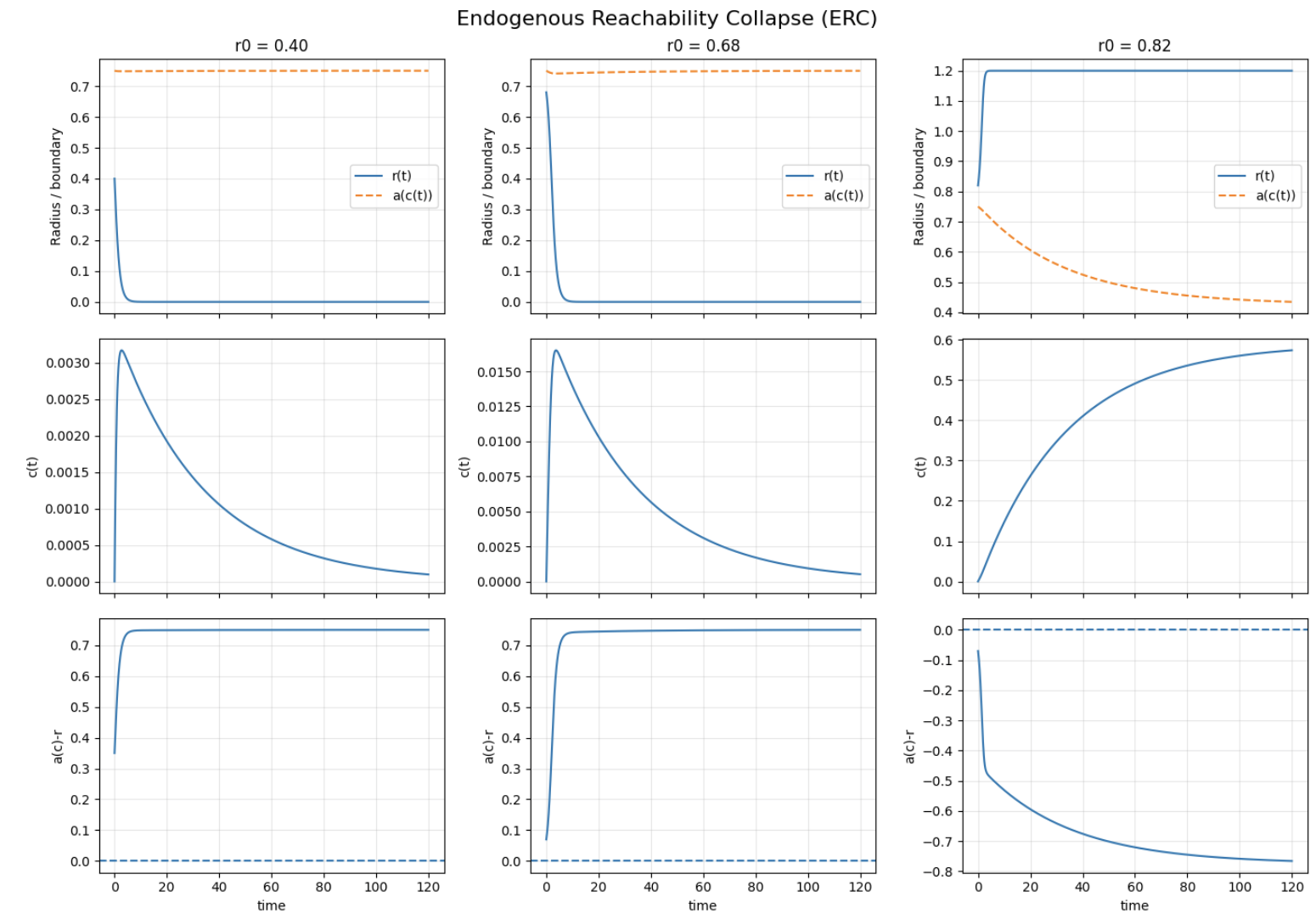
Endogenous Reachability Collapse (ERC) — Minimal Dynamical Model
A minimal dynamical system exploring whether loss of recoverability may emerge without removal of underlying states.
The model shows that a stable attractor can persist while becoming dynamically inaccessible due to an internal constraint that reshapes the effective accessibility boundary.
As trajectories evolve, a moving boundary in phase space determines whether recovery remains possible. Crossing this boundary results in loss of access to the attractor, despite its continued existence.
This suggests a separation between structural persistence and functional recoverability, governed by constraint-dependent accessibility within the state space.
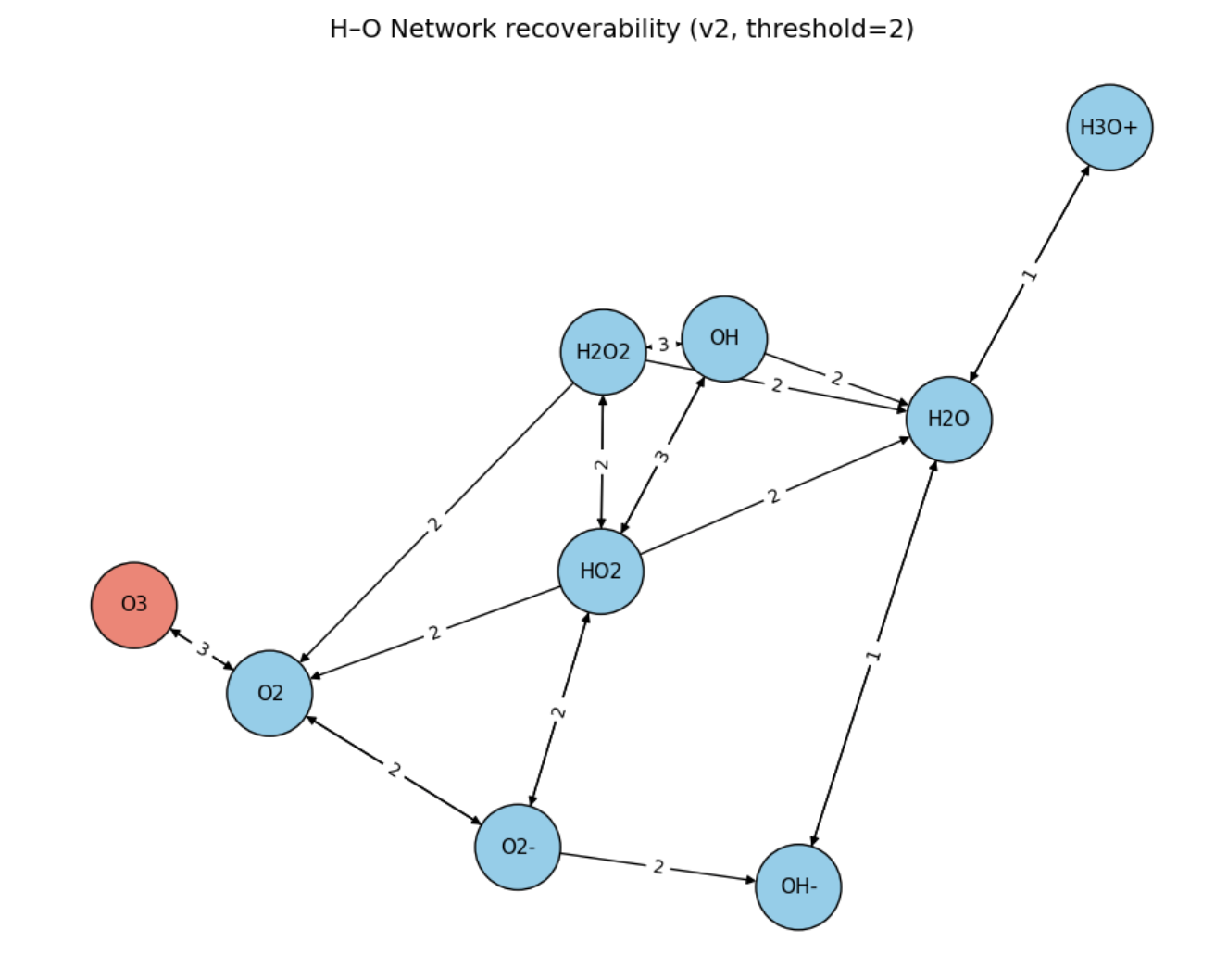
Structural Accessibility Boundary — Minimal H–O Redox Network
A minimal network-based model suggesting that recoverability may depend not only on the existence of return pathways, but on their accessibility under constraint.
By progressively restricting allowed transitions, the system may lose the ability to return to baseline configurations, even when the underlying structure remains unchanged.
This suggests a possible separation between structural integrity and functional recoverability, governed by constraint-dependent accessibility within the state space.
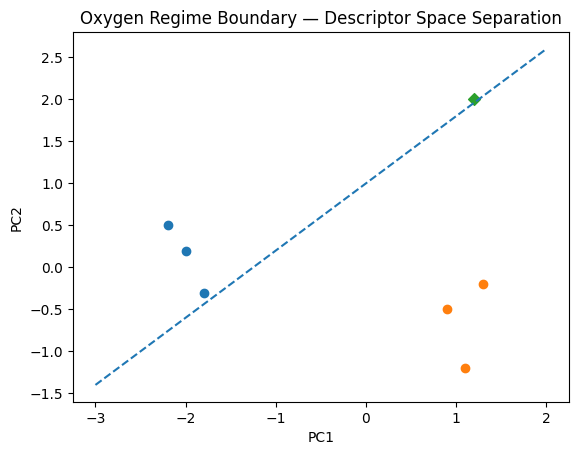
Oxygen Regime Boundary — Minimal Model
A minimal descriptor-based projection suggesting that oxygen species may separate into distinct regimes rather than forming a continuous space.
O–O and O–H dominated species appear to occupy different regions, with consistent placement of held-out species.
Status: Minimal model + preliminary separation in descriptor space
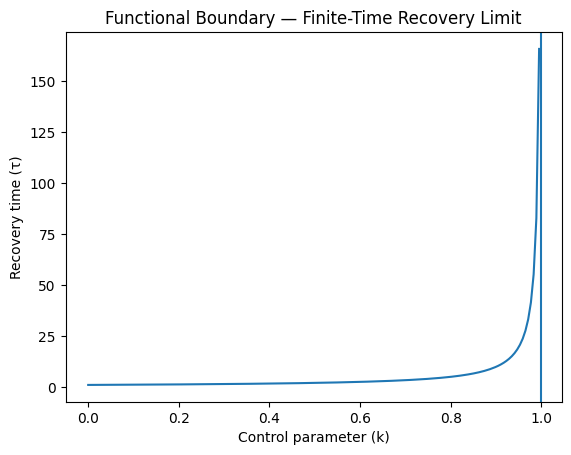
Functional Boundary Analysis in a 2D Nonlinear System
An operational framework suggesting that system failure may be defined by finite-time recovery constraints rather than asymptotic stability loss.
A boundary appears when recovery time exceeds a finite coherence window, rendering return dynamically inaccessible.
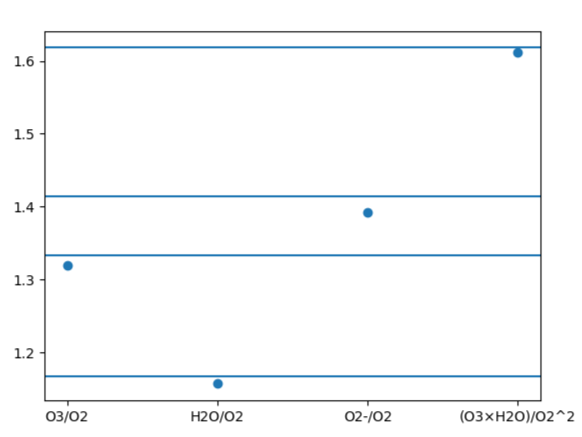
The Oxygen Octave — v1.6.1
A structural hypothesis suggesting that oxygen-related species may organize as a harmonic system, with ratios appearing to align with simple vibrational proportions.
Observed ratios appear to cluster near simple values (4/3, 7/6, √2, φ).
Status: Hypothesis-generating + reproducible framework