A Minimal Computational Framework for Accessibility Erosion and Operational Geometry
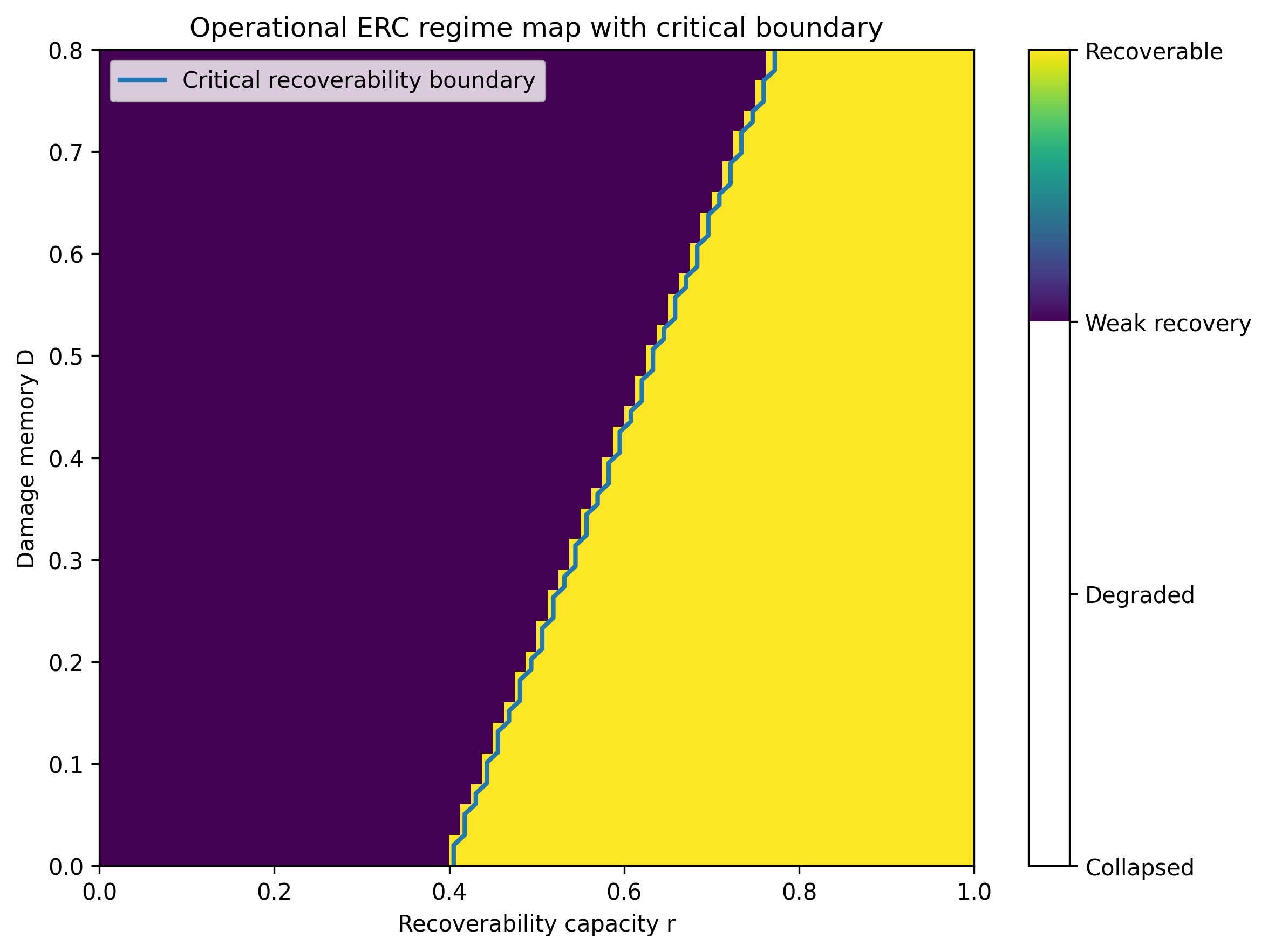
The simulations reveal progressively reorganized operational accessibility regions under repeated perturbation history. Recoverable and degraded future regions separate through an approximate recoverability boundary, suggesting that future accessibility may become increasingly constrained as accumulated damage memory grows.
A minimal computational framework exploring how repeated perturbation history may progressively reorganize future operational accessibility in recoverability-constrained dynamical systems.
This work investigates whether dynamical systems may remain operationally active while progressively losing access to recoverable future regions under repeated perturbation exposure.
Rather than asking only whether trajectories formally exist, the framework explores whether future operational regions remain dynamically reachable under finite recoverability constraints and accumulated operational memory.
Using a minimal recoverability-limited framework, the simulations explore how repeated perturbation history, recoverability depletion, and accumulated damage memory may progressively reorganize accessibility geometry despite identical external forcing schedules.
The resulting structure exhibits:
accessibility basin erosion,
phase-dependent recoverability,
internal operational accessibility geometry,
operational ERC regime maps,
approximate recoverability boundaries,
fragmentation thresholds,
scaling behavior across perturbation amplitudes,
localized hysteresis-like dynamics near accessibility cliffs,
and numerical robustness across discretization scales.
Importantly, the framework is intentionally minimal and operational.
No biological realism, detailed thermodynamic completeness, neural simulation, or physical spacetime modification is assumed.
Instead, the work explores recoverability-constrained accessibility dynamics as an operational computational framework.
The repository includes:
reproducible computational notebooks,
manuscript figures,
simulation outputs,
operational regime maps,
scaling analyses,
hysteresis experiments,
and processed computational outputs.
The central phenomenon explored throughout the framework is:
systems may remain dynamically active while progressively losing operational access to recoverable future regions under repeated perturbation history.
This framework may be relevant to broader questions involving:
recoverability-constrained dynamics,
resilience and accessibility loss,
rate-induced transitions,
stochastic fragmentation,
operational reachability,
finite-time recovery behavior,
and constrained dynamical accessibility analysis.
DOI (Zenodo)
https://doi.org/10.5281/zenodo.20310621
View Code (GitHub)
https://github.com/jaimeojse-collab/operational-future-accessibility
Related Frameworks
Previous ERC-related computational frameworks associated with this research direction:
The present work extends those ideas toward:
accessibility basin erosion,
operational geometry,
fragmentation thresholds,
scaling behavior,
localized hysteresis under repeated perturbation history,
and operational future accessibility organization under recoverability constraints.