Endogenous Reachability Collapse (ERC) — Minimal Recoverability Framework
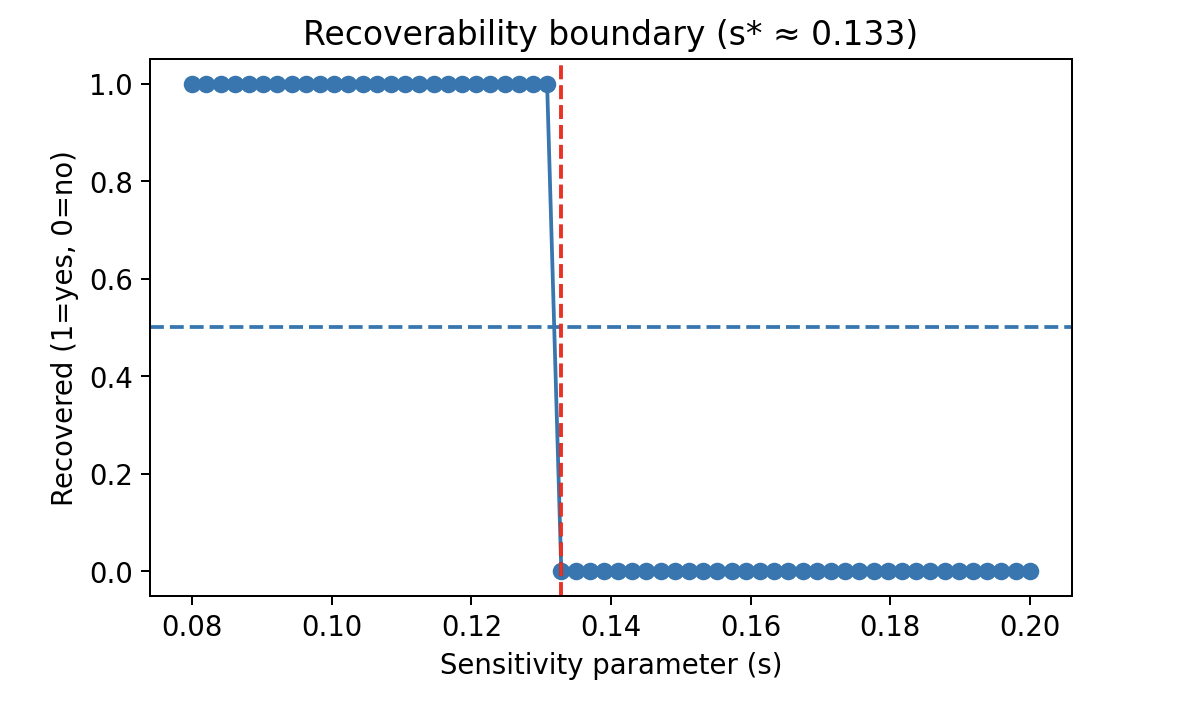
Recoverability boundary under increasing internal constraint.
The system retains valid states, but transitions abruptly from recoverable to non-recoverable regimes as accessibility is lost.
A minimal framework exploring whether system failure may emerge from loss of recoverability rather than loss of state space.
While traditional views associate failure with the disappearance of stable states, this work investigates the possibility that such states may remain present but become dynamically inaccessible.
The ERC framework introduces minimal dynamical systems designed to test whether recoverability depends on the relationship between input rate and internal recovery processes.
In this setting, collapse does not require removal of attractors, but may arise when the system is driven faster than it can resolve within a finite temporal window.
Numerical results suggest that perturbations with identical total magnitude (AUC) may produce different outcomes depending on their temporal profile.
Faster inputs may push the system beyond its recoverable regime, while slower inputs of equal magnitude may remain within accessible bounds.
This behavior appears consistent with a rate-dependent transition in accessibility, rather than a structural loss of available states.
The framework is intentionally minimal, open, and designed for falsifiability.
DOI (Zenodo)
https://doi.org/10.5281/zenodo.19240820View Code (GitHub)
https://github.com/jaimeojse-collab/erc-recoverability-model