Endogenous Reachability Collapse (ERC) — Rate-dependent Reachability Collapse
A temporal extension exploring how loss of recoverability may depend not only on the magnitude of perturbations, but on the rate at which they are applied.
While previous results suggest that internal constraints can render a stable attractor dynamically inaccessible, this work investigates whether accessibility may also depend on the relationship between input rate and recovery timescales.
To test this, time-dependent forcing is introduced into the ERC framework, allowing comparison between perturbations with identical total magnitude but different temporal profiles.
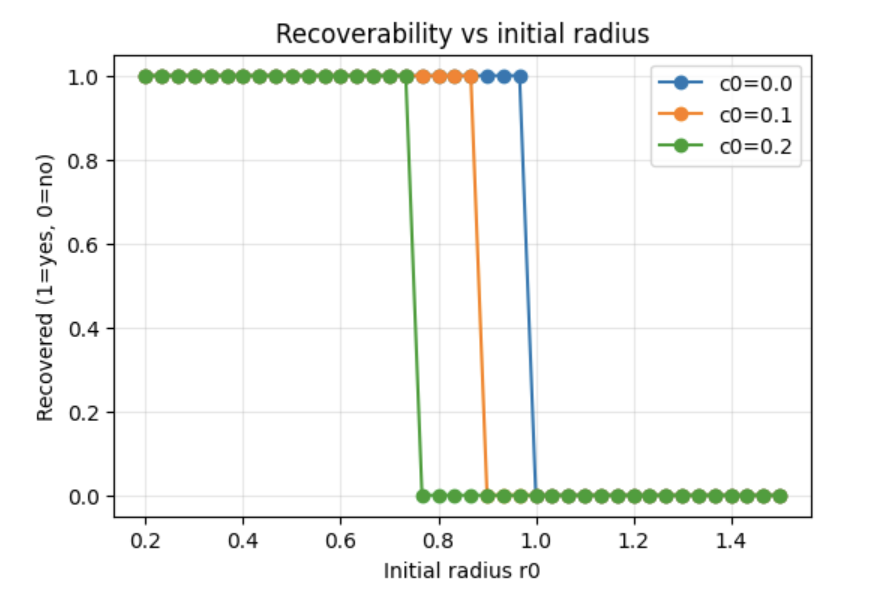
Numerical simulations suggest that collapse may depend strongly on input rate, even when total input (AUC) is held constant.
This indicates that two perturbations with identical total load may produce different outcomes, depending on how rapidly the system is driven relative to its recovery capacity.
Faster inputs may push the system beyond its recoverable regime, while slower inputs of the same total magnitude may remain within accessible bounds.
This rate dependence manifests as a shift in the effective recoverability threshold, as shown in the figure.
Within the explored range, this behavior appears consistent with a rate-dependent transition in accessibility.
The attractor remains present in the system, but becomes dynamically unreachable when the system is driven faster than it can recover.
This temporal perspective extends the ERC framework by introducing a second dimension of accessibility: not only where the system is in state space, but how quickly it is forced through it.