
Zenodo Papers
DOI-indexed conceptual frameworks, exploratory publications, methodological papers, and evolving research hypotheses.
-
HUMAN–AI SCIENTIFIC METHODOLOGY - How the research is conducted validated, and stress-tested
- Dec 14, 2025 From Zero to Open Question: A Controlled Stress Test of Human–AI Scientific Reasoning Under Maximum Transparency Constraints
- Dec 14, 2025 The Librarian Model — A Unified Human–AI Cognitive Architecture
- Dec 13, 2025 AI-Guided Structural Hypothesis Formation: The Oxygen Octave as a Case Study in Human–AI Coherence-Assisted Thinking (CAT)
- Dec 13, 2025 Dynamic Conversational Science (DCS): A Framework for Human–AI Co-Discovery
- Dec 12, 2025 THE LIVE-SIGNAL METHOD: A Framework for Real-Time Scientific Reasoning in Open Networks
- Dec 11, 2025 Methodological Clarifications, Falsifiability Criteria, Hallucination Analysis & Real-Time Open-Science Protocol.
-
FOUNDATIONAL FRAMEWORKS - Core conceptual and operational foundations of the Oxygen States framework
- Apr 3, 2026 Admissibility vs Accessibility: A Minimal Rate-Dependent Constraint on Reachability in Dynamical Systems
- Feb 5, 2026 The Admissibility Constraint: A Pre-Parametric Condition for Functional Systems
- Jan 3, 2026 Coherence as a System-Level Constraint: Limiting Function via Admissible Global Modes
- Dec 21, 2025 The Oxygen Octave – Foundations: Quantitative Correlations Across Vibrational Systems
-
STRUCTURAL INVARIANTS OF OXYGEN - Geometric electronic, and exchange-related constraints associated with oxygen organization
- Dec 18, 2025 The Oxygen Ladder: Minimal Geometric–Electronic Rearrangement as an Organizing Principle for Oxygen Chemistry
- Dec 17, 2025 The Oxygen Exchange Anisotropy Ratio (OEAR): A Reproducible Exchange-Driven Descriptor in Open-Shell Oxygen
- Dec 16, 2025 Pythagorean Harmonic Geometry as Oxygen-Curvature Invariance
- EXPLORATORY CASE STUDIES - Exploratory applications and non-claiming extensions of the framework
- GEOMETRIC CONTINUITY ACROSS SCALES - Cross-scale invariant structures spanning molecular thermal, and elastic regimes
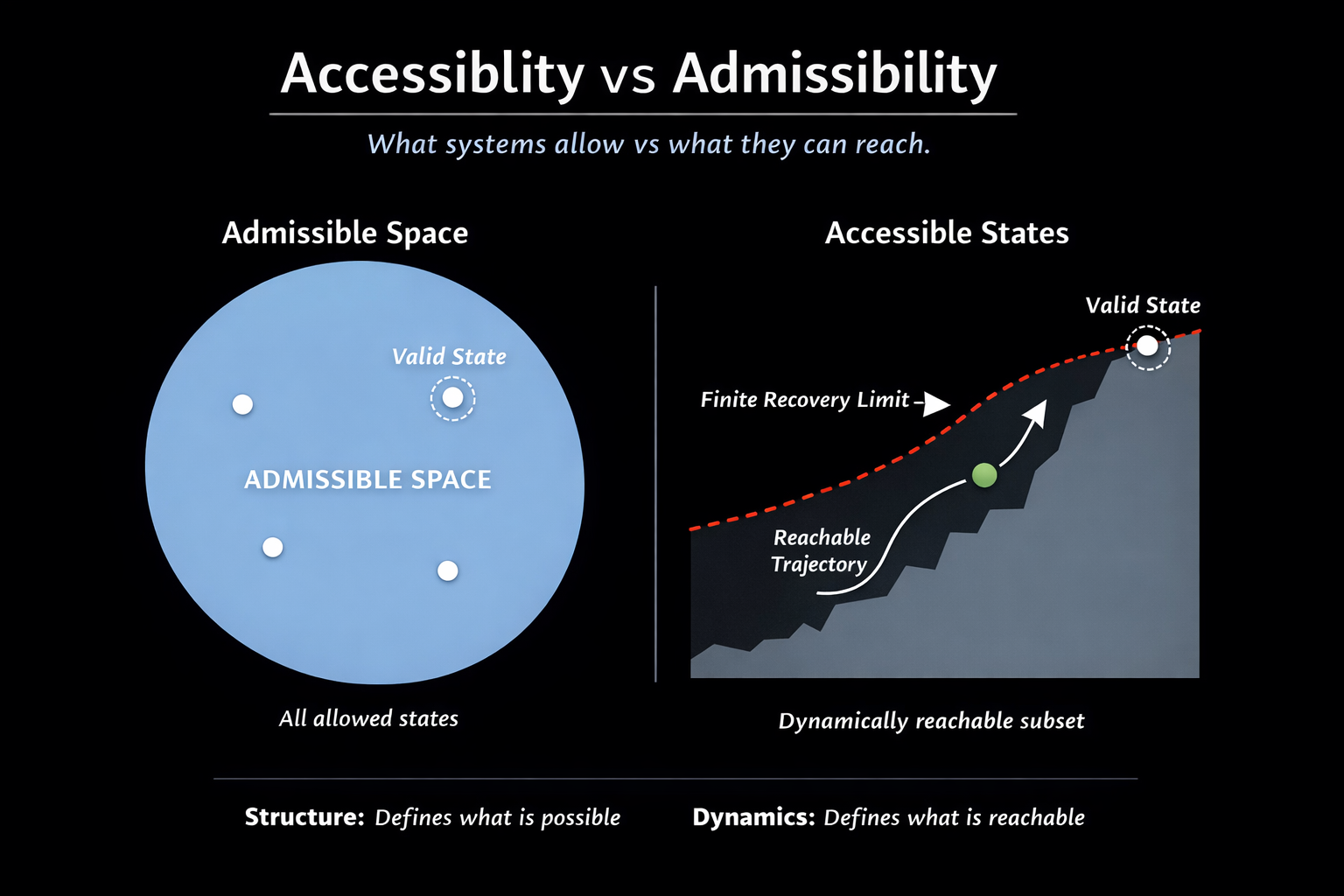
Admissibility vs Accessibility: A Minimal Rate-Dependent Constraint on Reachability in Dynamical Systems
Foundational preprint
This work extends the core admissibility condition by introducing a dynamical perspective on state reachability under finite recovery constraints.
Accessibility vs Admissibility (Zenodo, 2026) examines how systems may retain structurally valid states that become dynamically unreachable when recovery processes fail to keep pace with imposed demand
Abstract (Index version)
The accessibility vs admissibility distinction introduces a minimal dynamical refinement to the admissibility constraint.
A system may remain structurally well-defined — preserving its state space — yet lose functional access to specific states when recovery processes operate under finite rates.
In this view, failure does not necessarily arise from structural breakdown or state removal, but from a loss of dynamically admissible trajectories within a finite recovery window.
This framework suggests that system behavior may depend not only on total input or structural configuration, but on whether recovery dynamics remain sufficiently matched to the rate of perturbation.
Notably, increasing input intensity or optimization pressure may reduce accessibility, even when the underlying states remain intact.
The proposal is formulated as a falsifiable structural hypothesis, consistent with systems in which function depends on timely reintegration, including physical, biological, and information-processing domains.
DOI (Zenodo)
The Admissibility Constraint: A Pre-Parametric Condition for Functional Systems
Foundational preprint
The core admissibility condition underlying this project has been formally introduced as a standalone, falsifiable preprint.
The Admissibility Constraint: A Pre-Parametric Condition for Functional Systems (Zenodo, 2026) defines a substrate-independent condition that must hold before any oxygen-specific or vibrational framework becomes meaningful.
Abstract (Index version)
The Admissibility Constraint formalizes a minimal condition that must hold for any system to sustain function under perturbation.
A system is admissible if, after perturbation, it can re-enter a bounded region of functional equivalence within a finite coherence window sufficient to preserve functional identity.
This framework does not propose a mechanism, metric, or optimization principle. Instead, it specifies a necessary condition that must hold before parameterization, selection, or efficiency analysis becomes meaningful. Notably, increased speed, energy, or optimization may hasten functional collapse by reducing coherence time rather than restoring function.
The admissibility constraint is presented as a falsifiable structural hypothesis, applicable across physical, biological, informational, and cognitive systems whenever function depends on timely reintegration.
[Read full paper on Zenodo]
Coherence as a System-Level Constraint: Limiting Function via Admissible Global Modes
Abstract (Index version)
This work explores the hypothesis that function in biological and complex systems is constrained not primarily by energy availability or information throughput, but by the number of dynamically admissible global coordination modes.
We frame coherence as a system-level order parameter defined over an admissible region of state space, shaped by geometric and coupling constraints rather than by depletion of local resources. While systems may retain many local degrees of freedom, effective global degrees of freedom are sharply reduced by closure requirements, yielding only a small set of stable collective modes.
From this perspective, functional breakdown occurs when no admissible global configuration remains—not when energy or information are exhausted. This provides a unifying explanation for overload, fragility, and phase-transition–like behavior observed across biological, neural, metabolic, and engineered systems.
The framework is presented as a falsifiable conceptual model. No new empirical claims are asserted; instead, testable predictions are outlined to guide future experimental and computational validation.
[Read full paper on Zenodo]
The Oxygen Octave – Foundations: Quantitative Correlations Across Vibrational Systems
Abstract (Index version)
This version expands The Oxygen Octave from a proportional hypothesis into a structurally validated framework exploring harmonic organization in oxygen-based systems.
The model treats molecular oxygen (O₂) as a structural reference state from which coherent geometric and vibrational ratios emerge across chemical and biological contexts.
Rather than proposing a new physical law, this work examines whether stable functional patterns arise from persistent constraints, normalization, and admissible pathways across scales.
Version 1.6 introduces topological validation, comparative benchmarking, and a clearly defined experimental roadmap, positioning The Oxygen Octave as a testable and falsifiable structural hypothesis.
[Read full paper on Zenodo]
The Oxygen Ladder: Minimal Geometric–Electronic Rearrangement as an Organizing Principle for Oxygen Chemistry
Abstract (Index)
This document defines the methodological backbone of the Oxygen Octave project.
It introduces Coherence-Assisted Thinking (CAT), a transparent and falsifiable workflow in which human reasoning and general-purpose AI systems operate as a coupled loop to construct, test, and refine scientific questions.
Rather than advancing a new physical theory, the work demonstrates how structured interaction with AI can produce a coherent, auditable, and testable hypothesis under strict transparency constraints.
Oxygen is used as a controlled case study due to its well-characterized behavior across chemistry, physics, and biology, allowing rapid detection of inconsistencies or hallucinations.
This document serves as the methodological reference point for all subsequent Oxygen Octave publications.
Read full methodology on Zenodo
The Oxygen Exchange Anisotropy Ratio (OEAR): A Reproducible Exchange-Driven Descriptor in Open-Shell Oxygen
Abstract (Index)
This document introduces the Oxygen Exchange Anisotropy Ratio (OEAR), a compact and reproducible electronic descriptor observed across oxygen-centered open-shell species.
OEAR captures a stable ratio between α and β frontier-orbital energies that consistently separates closed-shell oxygen systems from oxygen-centered radicals and anions.
Rather than proposing a new theory of bonding, the work establishes OEAR as a diagnostic organizing parameter that emerges robustly across species, charge states, and computational methods.
The document’s role within the Oxygen Octave project is to provide a quantitative electronic anchor linking open-shell oxygen behavior to higher-level structural and coherence-based frameworks developed elsewhere in the project.
All numerical values, computational details, and reproducibility checks are provided in the full Zenodo record.
Read full report and data on Zenodo
Pythagorean Harmonic Geometry as Oxygen-Curvature Invariance
Abstract (Index)
This research note explores a structural correspondence between classical Pythagorean harmonic ratios and stable geometric configurations observed in oxygen-based molecules.
The work reframes traditional musical intervals not as numerological artifacts, but as curvature invariantsemerging from constrained molecular geometry, particularly in oxygen-centered systems.
Rather than asserting a new physical law, the document proposes that harmonic ratios may encode empirical regularities of vibrational geometry when bond angles are normalized and compared across molecular species.
Within the Oxygen Octave project, this note serves as a conceptual bridge linking molecular curvature, vibrational stability, and historically known harmonic structures, helping to contextualize later quantitative and topological results.
The full argument, numerical mappings, and historical comparisons are provided in the complete Zenodo record.
Read full research note on Zenodo
OXYGEN OCTAVE — Research Note II: Geometry–Thermal Invariance Across Scales
Abstract (Index)
This research note explores a proposed geometry–thermal invariance principle, suggesting that certain curvature-dependent vibrational features observed in oxygen-based molecules may persist across scales.
The work examines whether localized vibrational amplification—identified in constrained molecular geometries—can serve as an organizing motif linking molecular spectroscopy, thermal behavior, and larger resonant structures.
Rather than claiming direct physical coupling between scales, the note frames these observations as structural analogies constrained by geometry, intended to be testable within each domain independently.
Within the Oxygen Octave project, this document functions as a cross-scale hypothesis registration, motivating further experimental and computational validation without asserting a unifying law.
Detailed data, numerical estimates, and domain-specific discussions are provided in the full Zenodo record.
Read full research note on Zenodo
Curvature Thresholds as Geometric Continuity Minima: The √3 → √2 → φ Sequence in Elastic Systems under Strict Continuity
Abstract (Index version)
This preprint reports a recurring geometric regularity observed in elastic systems constrained by strict continuity and curvature minimization.
Across simulations of deformable loops under overlapping stabilizing fields, three numerical values consistently emerge as preferred configurations: √3, √2, and φ. These values appear as successive geometric regimes rather than isolated coincidences, suggesting a structured ordering of admissible curvature states.
The result is framed as a geometric continuity phenomenon, not a physical constant, and is explicitly dependent on dimensionality and topological constraints.
Within the Oxygen Octave project, this work serves as an external geometric control case, demonstrating that the same numerical sequence arises in non-chemical systems governed purely by continuity and minimization principles.
Falsifiable predictions and simulation details are provided in the full Zenodo preprint.
Read full preprint on Zenodo
From Zero to Open Question: A Controlled Stress Test of Human–AI Scientific Reasoning Under Maximum Transparency Constraints
Abstract (Index version)
This document establishes the methodological and epistemic foundation of the Oxygen Octave Project and the Coherence-Assisted Thinking (CAT) framework.
It documents a controlled experiment exploring whether a non-expert, working under strict transparency and falsifiability constraints, can use general-purpose AI systems to construct and refine a coherent scientific question.
Oxygen was selected as a case study due to its exceptionally well-characterized behavior across chemistry, physics, and biology, allowing structural inconsistencies and hallucinations to be readily detected.
Rather than presenting a scientific hypothesis, this work defines the constraints, reasoning loops, failure modes, and documentation standards of an openly auditable AI-assisted research process.
The document serves as the methodological origin of the project and frames failure itself as a scientifically valuable outcome when fully documented in real time.
[Read full methodology on Zenodo]
The Librarian Model — A Unified Human–AI Cognitive Architecture
An exploratory framework proposing that human cognition and AI systems may form coupled interpretive architectures capable of extending conceptual accessibility through iterative interaction, constraint, and feedback. Early conceptual precursor to the later ERC/recoverability framework.
Abstract (Index)
The Librarian Model explores the possibility that human cognition and large language models may form a coupled interpretive system rather than a simple user–tool interaction.
The work proposes that LLMs can behave as probabilistic structural spaces capable of reorganizing and extending conceptual accessibility when iteratively constrained by human intent, memory, and recursive feedback. Under this lens, meaning does not emerge exclusively from either the human or the model, but from the evolving interaction between both systems across time.
Rather than presenting a finalized theory of intelligence, the document functions as an exploratory framework for understanding AI-assisted cognition, symbolic continuity, and collaborative reasoning under uncertainty.
The text also represents an early stage in the broader evolution of the Oxygen States project, preceding later transitions toward operational recoverability, accessibility geometry, and falsifiable dynamical models.
Read full preprint on Zenodo
Atmospheric Down-Conversion of the Oxygen Vibronic Mode: A Technical Note on a Curious Numerical Alignment With the Schumann Fundamenta
This technical note documents a numerical proximity between the dominant vibronic transition of molecular oxygen and the Earth’s Schumann fundamental when scaled across multiple orders of magnitude using physically motivated divisors.
No physical coupling is claimed. The observation is presented strictly as a numerical alignment, framed to test whether multi-scale frequency relationships can emerge without invoking direct interaction mechanisms.
Within the Oxygen States project, this work functions as a boundary-case probe: a deliberately constrained example designed to separate structural coincidence from causal inference.
The note is explicitly speculative and fully falsifiable, intended as a computational prompt for atmospheric electromagnetism, cavity-mode analysis, and nonlinear optics simulations.
All assumptions, scaling steps, and limitations are detailed in the full Zenodo technical note.
Read full technical note on Zenodo
Thermal Coherence Transitions in Water — The φ-Lock Model (v1.0) Part of: The Oxygen Octave Series
Abstract (Index)
This work introduces the Φ-Lock Model, a temperature-dependent extension of the Oxygen Octave framework applied to phase transitions in water.
The model proposes that below a critical thermal threshold, molecular systems transition from disordered motion to a coherent regime characterized by stabilized geometric symmetry. This transition is framed as a dynamic coherence attractor, rather than a sharp thermodynamic phase boundary.
The Φ-Lock formulation provides a minimal, time-dependent description linking thermal noise reduction to the emergence of harmonic order in condensed media.
Within the Oxygen Octave project, this paper serves as the thermal continuity module, bridging molecular resonance, crystallization onset, and coherence dynamics under temperature variation.
Mathematical details, assumptions, and falsifiable predictions are provided in the full Zenodo preprint.
Read full preprint on Zenodo
AI-Guided Structural Hypothesis Formation: The Oxygen Octave as a Case Study in Human–AI Coherence-Assisted Thinking (CAT)
Abstract (Index version)
This document presents a transparent and falsifiable methodology for AI-assisted scientific hypothesis formation, using the Oxygen Octave as a worked case study.
The approach — Coherence-Assisted Thinking (CAT) — treats human intuition and general-purpose AI systems as a coupled reasoning loop, where hypotheses are iteratively generated, stress-tested, refined, and publicly documented.
Rather than proposing a new physical theory, the work demonstrates how structured interaction with AI can produce a coherent, auditable, and testable scientific hypothesis under strict transparency constraints.
The Oxygen Octave serves as a controlled domain due to oxygen’s well-characterized behavior across chemistry, physics, and biology, enabling rapid detection of structural inconsistencies or hallucinations.
All reasoning steps, intermediate failures, data sources, and revisions are preserved through public versioning, allowing independent replication, critique, and extension.
[Read full methodology and technical details on Zenodo]
Dynamic Conversational Science (DCS): A Framework for Human–AI Co-Discovery
Dynamic Conversational Science (DCS) is a methodological framework that formalizes human–AI interaction as a unified cognitive system for scientific inquiry.
Rather than treating AI as a tool or oracle, DCS models discovery as an iterative conversational loop in which probabilistic generation (AI) is constrained by memory, intention, and temporal coherence (human).
Within the Oxygen States project, this work functions as the methodological backbone that enables all subsequent structural hypotheses, stress tests, and falsification protocols.
The framework defines its own scope, limitations, and failure modes, and is presented explicitly as reproducible and auditable rather than outcome-guaranteeing
This document serves as the first formal registration of DCS as a generalizable method for real-time conceptual discovery in open scientific networks.
Full methodological details, constraints, and reproducibility notes are provided in the Zenodo record.
Read full framework on Zenodo
THE LIVE-SIGNAL METHOD: A Framework for Real-Time Scientific Reasoning in Open Networks
Abstract (Index)
The Live-Signal Method is a methodological framework for real-time scientific reasoning in open information networks.
It formalizes how early-stage scientific intuition can be shaped, constrained, and refined using live network signals and AI-assisted structural falsification, prior to formal experimentation.
Rather than replacing the classical scientific method, the Live-Signal Method reorganizes its front-end cognitive phase: signal detection, intuition filtering, structural clarification, and pre-hypothesis formation
Within the Oxygen States project, this method operates as a real-time signal intake layer, enabling high-volume public information streams to be transformed into traceable, falsifiable scientific questions
The framework explicitly preserves falsifiability and empirical rigor while accelerating the reasoning trajectory that precedes experimental design.
This document is a methodological preprint. No empirical claims are made.
Full methodological details and examples are provided in the Zenodo record.
Read full preprint on Zenodo
Methodological Clarifications, Falsifiability Criteria, Hallucination Analysis & Real-Time Open-Science Protocol.
Abstract (Index)
This document provides formal methodological clarifications for the ongoing Oxygen Octave project.
Its purpose is to explicitly separate empirical observations, geometric regularities, and computational results from heuristic analogies, speculative interpretations, and narrative framing.
The document defines:
clear falsifiability conditions for each major hypothesis,
explicit boundaries of what the model does and does not claim,
removal of ad-hoc scaling assumptions,
normalization and justification of numerical procedures,
and a structured framework for identifying and classifying AI hallucinations.
It further outlines a computational testing roadmap and documents known limitations, provisional assumptions, and future verification paths
This note is intended to strengthen transparency, improve methodological rigor, and enable independent auditing of the full reasoning process.
This is a methodological control document.
No new empirical claims are introduced.