Oxygen and sulfur appear to define a shared local geometry in multivariable periodic table space
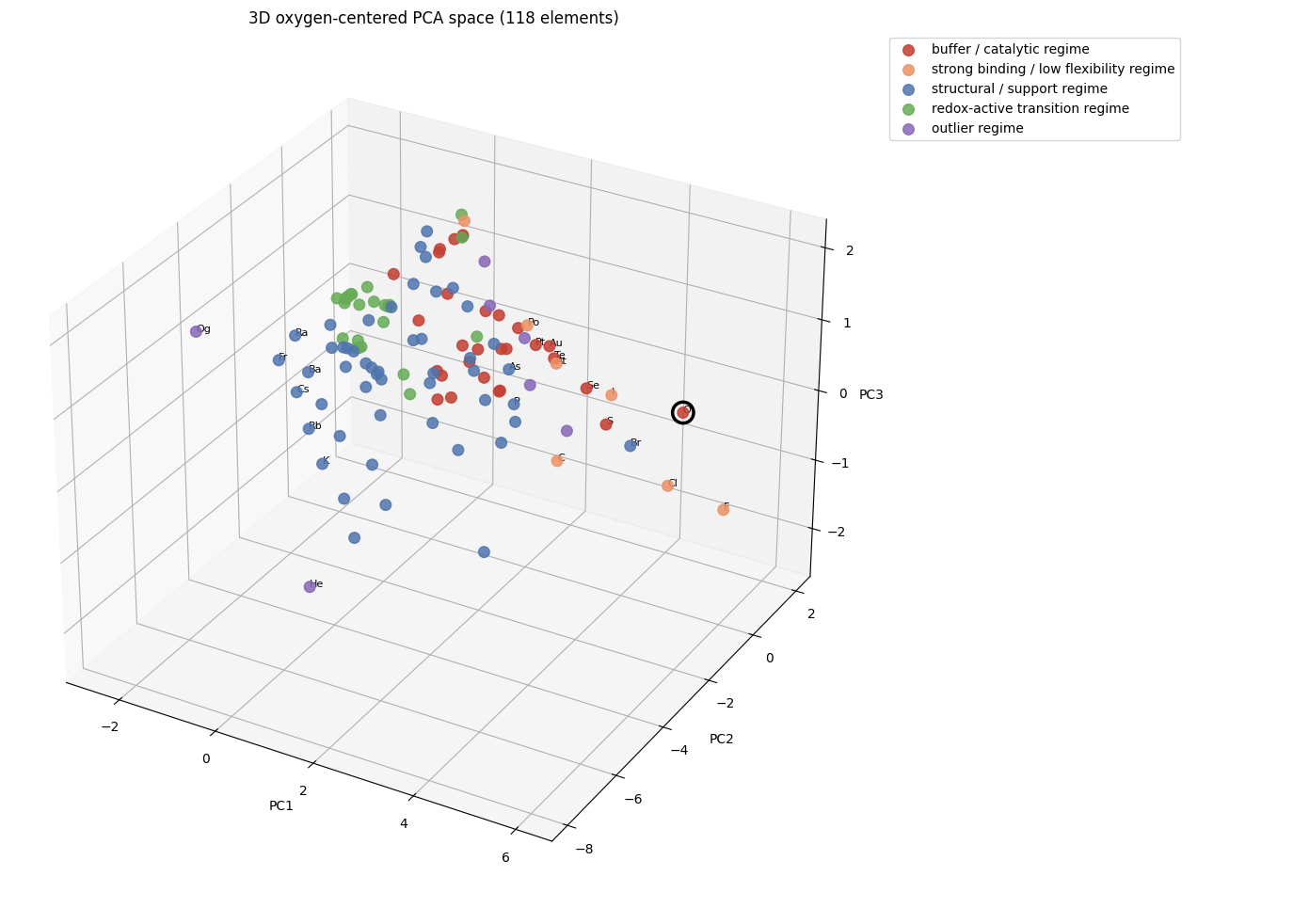
Representative 3D oxygen-centered PCA space across the 118-element periodic table.
Elements are positioned according to a shared multivariable embedding built from electronegativity, electron affinity, ionization energy, oxygen-affinity proxy, redox-flexibility proxy, group, and period.
Oxygen appears inside a limited local neighborhood enriched in sulfur-family elements, halogens, and catalytically active metals, while noble gases and alkali metals remain structurally distant.
A multivariable oxygen–sulfur geometry.
A multivariable analysis exploring whether oxygen occupies a distinct and non-random neighborhood across the periodic table.
While oxygen is often treated as a chemically central element, this work examines whether its position remains unique when multiple elemental properties are considered simultaneously.
We constructed a shared PCA space using electronegativity, electron affinity, first ionization energy, oxygen-affinity proxy, redox-flexibility proxy, group, and period.
All 118 elements were then ranked according to Euclidean distance from oxygen in the shared multivariable space.
Results suggest that oxygen occupies a structured local neighborhood enriched in sulfur-family elements, halogens, and catalytically active metals.
This local organization remained broadly stable across dimensional changes, variable removal, and restriction to a higher-confidence subset of elements.
Among the tested reference elements, sulfur reproduced the oxygen-centered neighborhood most closely and generated the most compact local geometry.
These observations are consistent with the possibility that oxygen and sulfur define a broader shared chemical axis rather than a fully isolated oxygen-centered regime.
This analysis does not demonstrate chemical centrality directly, but provides a robust multivariable pattern consistent with a persistent oxygen–sulfur local structure.
The framework is intentionally minimal, open, and designed for falsifiability.
• DOI (Zenodo)
https://doi.org/10.5281/zenodo.19634706
• View Code (GitHub)
https://github.com/jaimeojse-collab/oxygen-sulfur-local-geometry
This work may be consistent with broader questions about oxygen-centered structural regimes, catalytic mediation, redox flexibility, and multivariable accessibility across chemical state space.