Oxygen-relative chemical space may encode structured dynamical accessibility regimes
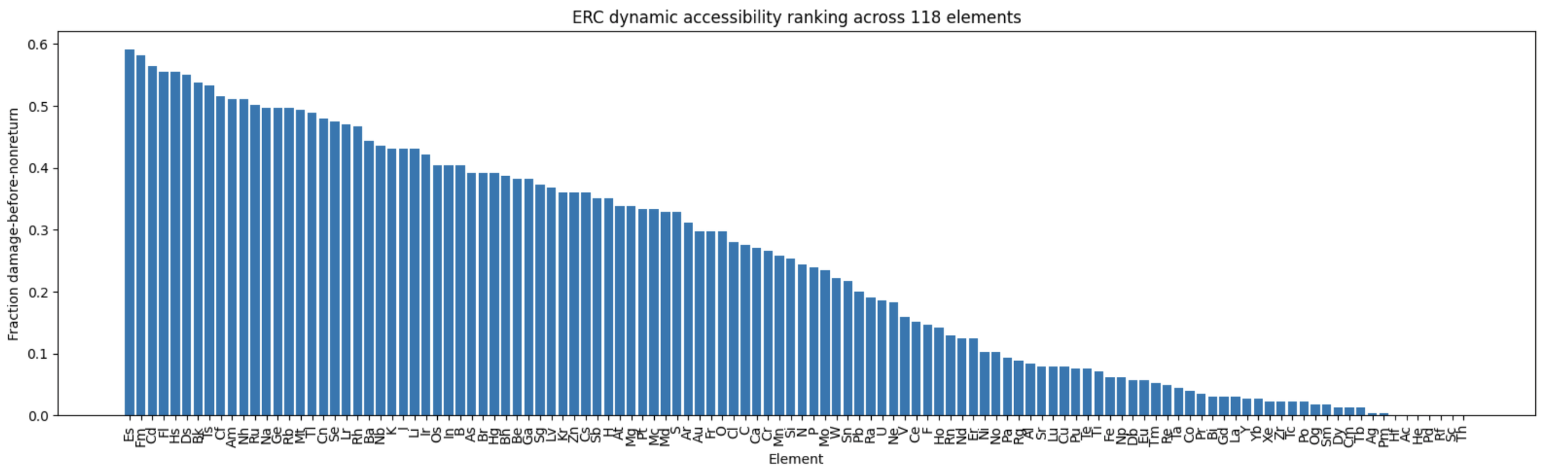
Oxygen-relative chemical space reveals structured dynamical regimes. Each point represents an element positioned by its distance to oxygen and its fraction of trajectories exhibiting damage-before-nonreturn behavior.
A minimal dynamical framework exploring recoverability-constrained behavior across the periodic table.
A minimal oxygen-centered dynamical system.
This work explores whether dynamical accessibility across chemical elements is determined solely by geometric proximity, or whether recoverability constraints introduce structured regimes.
While chemical space is often treated as static, this framework evaluates how elements respond to transient forcing and whether trajectories remain dynamically accessible within finite recovery times.
Each element is embedded in an oxygen-relative geometry and subjected to a minimal recoverability model defined by a relaxation term and transient Gaussian forcing.
Across all 118 elements, distinct dynamical regimes emerge based on the ordering of two operational transitions:
damage onset and non-return.
These regimes do not appear to collapse into a simple function of distance
Instead, elements cluster into structured behavioral classes, suggesting that accessibility may be constrained—but not fully determined—by geometry.
A shuffled control removes this structure, indicating that the observed organization is not an artifact of sampling.
This analysis does not assert a fixed chemical hierarchy, but provides a minimal and falsifiable framework to probe accessibility-constrained organization in chemical space
• DOI (Zenodo)
https://doi.org/10.5281/zenodo.19838303
• View Code (GitHub)
https://github.com/jaimeojse-collab/periodic-erc-model
This work may be consistent with broader questions about recoverability, rate-constrained dynamics, and accessibility in oxygen-mediated chemical systems.