Oxygen-centered dynamical organization of chemical space
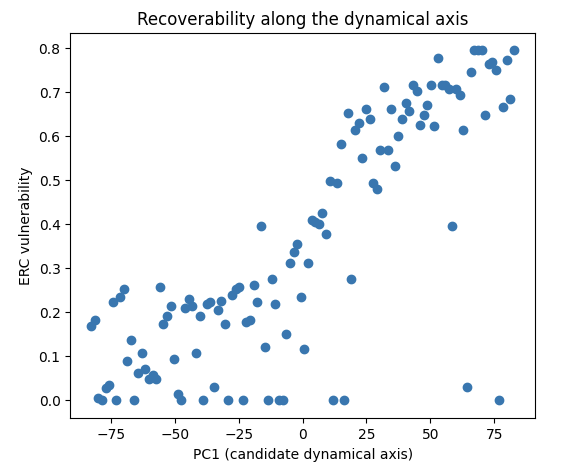
Recoverability (ERC vulnerability) along the candidate dynamical axis (PC1).
A structured gradient appears to emerge despite weak correlation with simple geometric distance metrics.
A minimal ERC-based framework exploring whether chemical space may exhibit structured variation in dynamical accessibility.
This work explores whether oxygen-centered representations of chemical space may reveal an underlying dynamical organization.
While chemical space is typically described in terms of similarity and static properties, this framework asks a different question:
not just which states exist — but which remain dynamically reachable.
Using a minimal Endogenous Reachability Collapse (ERC) framework, each element is embedded relative to oxygen and subjected to controlled perturbations, allowing the system to be probed in terms of recoverability rather than proximity alone.
This framework extends prior observations from oxygen-centered geometry and oxygen-relative chemical space by introducing a dynamical criterion: recoverability under transient forcing, suggesting that these structures may reflect a dynamical constraint rather than purely geometric organization.
Related work:
Oxygen and sulfur appear to define a shared local geometry in multivariable periodic table space
Oxygen-relative chemical space may encode structured dynamical accessibility regimes
• DOI (Zenodo)
https://doi.org/10.5281/zenodo.20026665
• View Code (GitHub)
https://github.com/jaimeojse-collab/oxygen-centered-dynamical-organization/tree/main
This work may be consistent with broader questions on recoverability, rate-constrained dynamics, and accessibility in oxygen-mediated chemical systems.