Dynamic Accessibility Organization Under Perturbation–Recovery Constraints
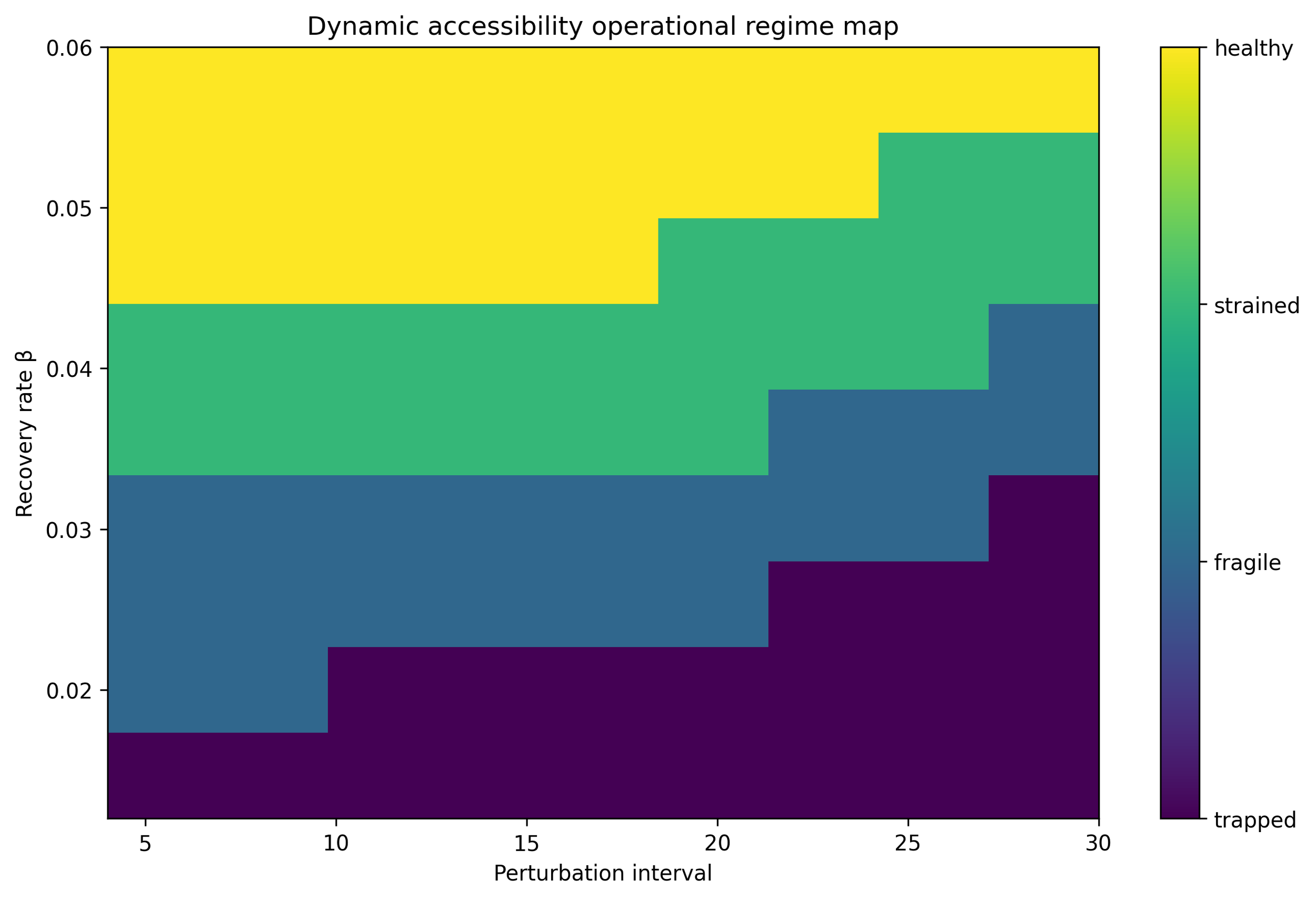
Accessibility organization across perturbation–recovery parameter space. Operational regions emerge despite preserved scaffold and should be interpreted heuristically rather than as hard physical boundaries.
Operational summary
This work introduces a minimal computational framework exploring whether systems may preserve structural scaffold while progressively reorganizing which future trajectories remain operationally accessible under perturbation–recovery constraints. Rather than assuming that accessibility loss necessarily requires explicit structural disconnection, the framework evaluates whether perturbation timing, recovery kinetics, perturbation history, and stochastic variability may reorganize accessibility while scaffold structure remains preserved. Using a minimal lattice-based computational abstraction with fixed connectivity and dynamically evolving traversability, the simulations suggest that accessibility organization may emerge operationally through changing reachable futures, accessibility cost, weighted efficiency, and perturbation-history effects despite preserved scaffold. Under explored conditions, identical perturbation burden does not necessarily imply identical accessibility futures. Importantly, the present framework should be interpreted as an exploratory and falsification-oriented computational abstraction rather than a fitted mechanistic model of real systems.
DOI (Zenodo)
https://doi.org/10.5281/zenodo.20401824
View Code (GitHub)
https://github.com/jaimeojse-collab/ERC-Dynamic-Accessibility-Lattice
Related Frameworks
Previous ERC-related computational frameworks associated with this research direction: